

The prevailing global discourse fixates upon South Africa's egregious unemployment figures as an economic malady. This is a profound misdiagnosis. Let us dispense with the tired shibboleths of labour market rigidities and structural inequalities. These are not the root disease; they are merely the most visible sequelae of a far more fundamental and corrosive systemic failure. The Republic is not suffering from a deficit of jobs; it is suffering from a devastating leadership vacuum, a fundamental failure in strategic execution, and governance.
This distinction, semantic only to the uninitiated, is the critical strategic pivot upon which all investment, policy, and geopolitical engagement must now turn. What premium can one logically place upon vast market potential when the very architecture of decision is fundamentally compromised? This is the urgent philosophical and financial question for every global CEO, technology magnate, and policy shaper observing the continental landscape. The conventional economic models applied to South Africa treat the nation’s challenges as a deficiency of resources; the more accurate assessment reveals a severe deficiency of executive will and strategic fidelity.
The country is beyond labour economics: the crisis is not technical; it is strategic and institutional. This is not a labour market failure. It is a leadership failure. The unemployment crisis is not a mystery. It is a mirror. It reflects the choices, omissions, and failures of those entrusted with the stewardship of the nation. To speak of unemployment without interrogating leadership is to diagnose symptoms while ignoring the disease.
A Nation Adrift: Why Jobs Are Not the Crisis, But Leadership is the Real Catastrophe
What if unemployment in South Africa were not the problem at all? What if the unemployment rate – an eye-watering 33.2% in Q2 2025, the highest in the world – were merely the symptom of a more profound collapse? The conventional diagnosis is mistaken. The disease is not joblessness. It is leadership failure. The expanded unemployment rate, which includes those who have ceased seeking work out of frustration or despair, now stands at a staggering 42.9%.
For decades, we have debated skills shortages, labour inflexibility, education reform, and foreign investment pipelines. Yet the jobs crisis grows. Why? Because the issue is not economic mechanics. It is not about jobs per se. It is about a failure of vision, execution, and accountability among those entrusted with power. Unemployment is not the tragedy. The tragedy is the vacuum at the top.
Why then do we continue to accept the prevailing narrative that attributes South Africa’s unemployment crisis to macroeconomic headwinds, structural inequality, and global volatility? While these factors are undeniably contributory, they are not causative in isolation. The root of the problem lies in a persistent and systemic leadership vacuum. It is not the absence of jobs that defines the South African condition. It is the absence of vision, accountability, and institutional courage.
Reframing the Crisis: Unemployment as the Visible Scar, Leadership as the Hidden Wound

Why do nations with fewer resources than South Africa create thriving labour markets, while Africa’s most industrialised economy stagnates? Nigeria, with its chaotic governance, still manages an informal economy that teems with ingenuity and enterprise. Vietnam, scarred by decades of war, has transformed into a manufacturing powerhouse, lifting millions out of poverty.
The answer lies in leadership. South Africa does not lack industrious people. It lacks leaders who can marshal resources, attract capital, and create predictable environments in which businesses can flourish. Every entrepreneur sidelined by bureaucracy, every investor deterred by policy incoherence, and every skilled youth excluded from opportunity is not evidence of unemployment, but of abdicated leadership.
The Statistical Fiction: Unmasking the Deeper Political Economy
The accepted narrative is one of a structurally crippled economy, unable to absorb its youth dividend. The statistical truth, whilst alarming, distracts from the political economy’s core failure: an inability to prioritise, plan, and, crucially, execute. When a state-owned utility such as Eskom requires repeated, colossal bailouts, it is not primarily an energy crisis; it is an indictment of governance capacity. When sophisticated infrastructure projects stall indefinitely, the failure is not budgetary; it is managerial.
Should not the world’s financial elite demand an explanation for the perennial gap between national ambition and on-the-ground reality? The true crisis is the dilution of accountability. The market’s confidence is not eroded by volatility alone; it is annihilated by the perceived impunity of incompetence. We must acknowledge that the policy frameworks are often sophisticated, yet the machinery of state required to translate theory into tangible output is chronically rusted. This creates an environment of profound institutional drift.
Visionary Paralysis: The Failure to Transcend Administrative Potholes

Leadership, in this context, must be redefined not as mere administration, but as the visionary alignment of national capacity with a future-facing global economy. Where is the strategic calculus that decisively positions South Africa for the Fourth Industrial Revolution? The country possesses world-class academic institutions, a vibrant financial sector, and mineral wealth essential for the global energy transition. Yet, these assets remain a geographically anchored potential, seldom synergised by a unifying national grand strategy.
The current political environment is characterised by an exhausting preoccupation with administrative potholes rather than the construction of economic superhighways. This paralysis at the political apex filters down, creating a cautious, risk-averse, and ultimately, opportunity-deferring corporate culture. The most pernicious effect of this leadership deficit is the exodus of elite human capital. Are we to simply accept that the most talented, entrepreneurial minds must seek governance structures elsewhere to realise their full potential? The cost of this intellectual haemorrhage far surpasses any cyclical budgetary shortfall.
State Paralysis and Strategic Drift: Bureaucratic Inertia Blocks Reform, While Mismanagement Deepens Exclusion
The South African state has demonstrated a chronic incapacity to translate policy into execution. Labour market reforms remain stalled in bureaucratic inertia. Regulatory burdens stifle business dynamism. Urban planning continues to isolate workers from opportunity. The transition from coal and other legacy sectors is mismanaged, leaving entire regions economically stranded. These are not technical oversights. They are strategic omissions.
Private Sector Apathy: Corporate South Africa has Retreated from National Responsibility
In the private sector, the response has been equally anaemic. Corporate South Africa has largely retreated into risk aversion, prioritising shareholder returns over national regeneration. The rhetoric of inclusive growth is ubiquitous, yet its practice remains elusive. Investment in workforce development, entrepreneurial ecosystems, and scalable job creation has been sporadic and insufficient. The leadership vacuum is not confined to government. It is endemic.
The Human Cost of Inaction: Unemployment Is Not Just Economic, It Is Existential
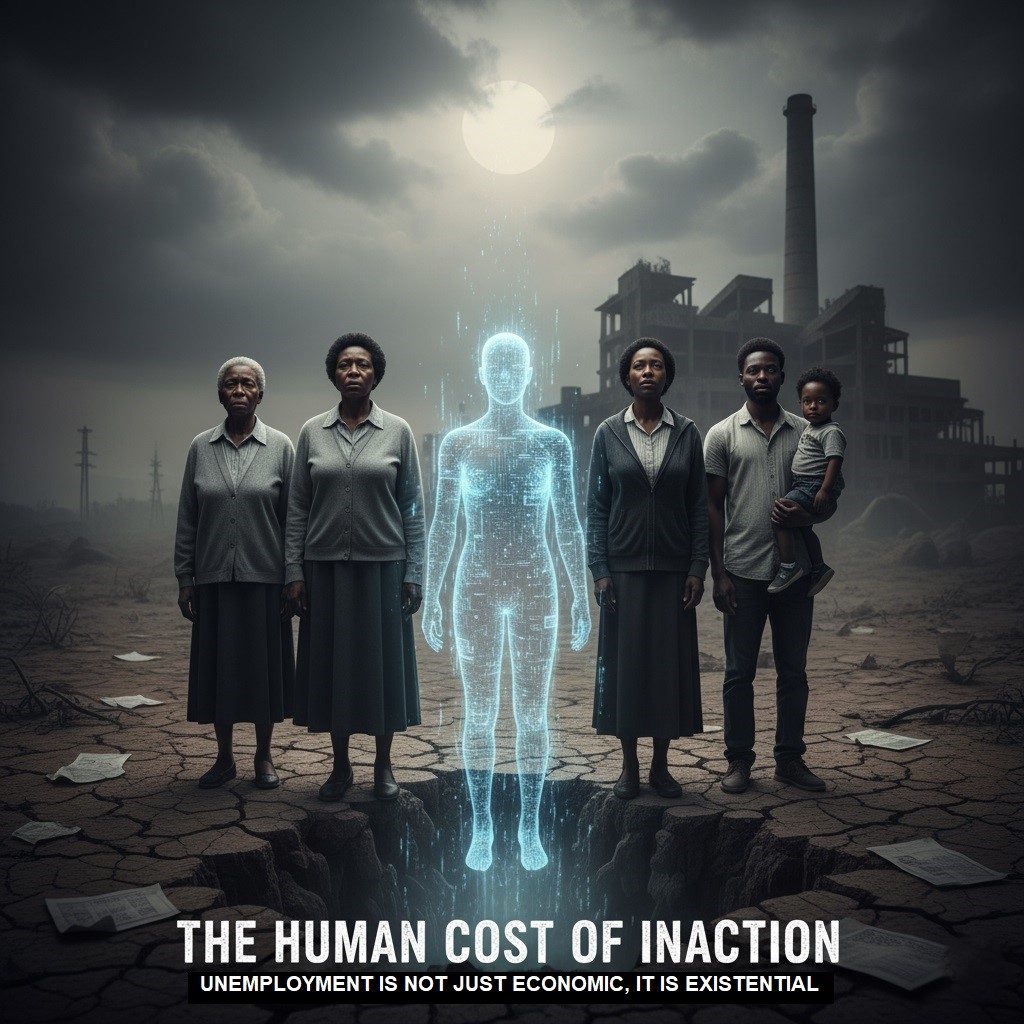
The consequences are profound. Long-term unemployment now affects 76.5 percent of jobless South Africans. This is not merely an economic statistic. It is a social fracture. It erodes civic trust, fuels populist sentiment, and destabilises democratic institutions. It also drives an exponential rise in all forms of crime, especially violent crime, turning economic exclusion into a breeding ground for desperation, unrest, and social collapse. A nation that cannot integrate its youth into productive activity is a nation at risk of systemic decline.
Talent Abounds, Vision Does Not: South Africa’s Youth Are Idle by Design, Not by Choice
South Africa does not suffer from a shortage of talent. It suffers from a shortage of vision. The youth are not idle by choice. They are idle by design. The economy is not stagnant by accident. It is stagnant by neglect.
The Illusion of Technical Fixes: Why Piecemeal Reforms Never Deliver Systemic Change
Is the solution another skills programme? Another tax incentive? Another temporary youth wage subsidy? These interventions, endlessly recycled by policymakers, deliver negligible results because they tinker with symptoms while avoiding the root cause.
Consider the National Development Plan, once hailed as South Africa’s grand strategy. Its targets have collapsed under the weight of indecision and lack of political will. Education reform remains frozen in mediocrity because leadership refuses to confront entrenched interests. Energy policy lurches from crisis to crisis, not for want of engineers, but for want of leaders who can commit to a coherent course.
Without leadership, reforms become slogans. With leadership, even imperfect systems can deliver momentum. Rwanda, often held up as an African paradox, demonstrates this. Scarce resources and a difficult history did not prevent it from achieving growth, because leadership imposed discipline, prioritisation, and a national sense of direction.
Case Studies of Consequence: Lessons for South Africa and Global Corporations

The private sector is not immune to the leadership vacuum. Eskom, South Africa’s state utility, once ranked among the world’s most efficient power producers. Today, it epitomises institutional decay, with rolling blackouts crippling productivity, now called load reduction. The crisis is not technical; South Africa has engineers who can fix turbines. The crisis is leadership incapable of making bold decisions, resisting vested interests, and restoring trust.
Contrast this with global corporations that thrive precisely because leadership chose differently. Microsoft, in decline during the early 2010s, reinvented itself under Satya Nadella. His leadership shifted focus from declining legacy products to cloud computing, positioning the firm at the centre of global digital infrastructure. The lesson is simple: strategic clarity and decisive leadership can redirect even seemingly stagnant institutions.
In South Africa, the example of Discovery Limited is instructive. While public healthcare limps under inefficiency, Discovery created a health and financial services ecosystem admired globally. Its success was not a matter of favourable conditions but of leadership that anticipated consumer needs, innovated relentlessly, and built trust over decades. Discovery proved that leadership, not environment, is the ultimate differentiator.
Global Comparisons, Local Failures: South Africa’s Labour Metrics Are the Worst Among Its Peers
The OECD’s 2025 Economic Survey of South Africa places the country at the nadir of global labour market performance, with the lowest employment rate and the highest unemployment rate among OECD and G20 nations. Unlike peer economies where informal employment acts as a buffer, South Africa’s informal sector is anaemically underdeveloped. This results in widespread exclusion, with millions neither working nor training, nor studying.
Key findings on South Africa's labour market:
Low employment rate: South Africa's employment rate is around 40%, which is significantly lower than the G20 emerging-market average of about 60%.
High unemployment rate: The unemployment rate is extremely high, exceeding the G20 average by about 25 percentage points.
High exclusion: A significant portion of the population remains outside of the labour market, and unlike in other emerging economies, they are not turning to informal work, indicating high exclusion.
Specific vulnerabilities: Unemployment rates are even higher for young people (around 60%) and women (around 34%).
Contributing factors: The OECD survey points to several factors, including restrictive regulations that hinder job creation, and issues with urban sprawl and insufficient public transport that make it difficult for people to get to work.
Exacerbated by other issues: The report also notes that frequent power outages and port bottlenecks have negatively impacted economic growth, which in turn limits job creation.
The NEET rate – those Not in Employment, Education, or Training – stands at a staggering 45.1 percent for youth aged 15 to 34 (Stats SA, first quarter of 2025). Gender disparity:
The rate is higher for young women (48.1%) than for young men (42.2%) in the 15-34 age range. Significance:
This high rate points to a significant challenge for young people in South Africa, as those who are NEET are more vulnerable to social exclusion, poverty, and mental health issues. Broader Population (15–60 years): 43.7% in 2024.
Why is the NEET Rate Important?
Full Picture of Labour Market Activity: The NEET rate includes young people who are not actively participating in the labour market (employment) and also not engaged in formal learning or skill development.
It's a useful metric because traditional unemployment figures often overlook young people who are outside the labour force but not in education or training.
Economic Impact:
A high NEET rate signals a substantial loss of human potential and contributes to broader unemployment issues.
Social Exclusion:
It indicates that a large segment of the youth population is not equipped with the skills needed for the job market and are at higher risk of social isolation.
Policy Focus:
The NEET rate helps governments and organisations understand the scale of the problem and design targeted interventions to support these individuals.
Global Stakes: Why This Matters Beyond South Africa’s Borders
Why should world leaders, global CEOs, and high-tech lords care about South Africa’s leadership vacuum? Because instability is contagious. South Africa is not a peripheral economy. It is the most industrialised state on the continent, a hub for finance, mining, agriculture, and technology. Its ports and supply chains connect Africa to the world. Its collapse would reverberate far beyond its borders.
For global corporations, the lesson is universal. Whether in Johannesburg or New York, Shanghai or São Paulo, the determinant of organisational health is leadership. Talent pools can be deep. Capital can be abundant. Technology can be advanced. But without leaders who embody clarity, courage, and accountability, none of it translates into sustainable value.
What Must Be Done: From Diagnosis to Prescription
What, then, does true leadership look like in practice?
First, it requires the courage to simplify complexity. South Africa’s leaders must abandon jargon-heavy policy documents and articulate three or four decisive priorities: energy security, education excellence, investment certainty, and institutional integrity.
Second, it requires the discipline of execution. Leaders must abandon endless consultations and timelines stretching into decades. The private sector can lead here. Anglo American, for example, has piloted renewable energy projects in South Africa that could stabilise grid supply faster than state-led interventions. Corporations globally can draw from this example: do not wait for political systems to align, but create models of execution that outpace inertia.
Third, it requires the moral authority of accountability. Leaders must be held to account for results within fixed time horizons. CEOs face quarterly earnings calls. Political leaders, too, must face performance-based legitimacy rather than rhetorical grandstanding.
Reinvention, Not Reform: South Africa Needs Catalytic Leadership, Not Ceremonial Governance
What is required is not incremental reform but strategic reinvention. South Africa must cultivate a new generation of leaders in government, business, and civil society, who are capable of confronting complexity with clarity and inertia with innovation. Leadership must cease to be a ceremonial function and become a catalytic force.
Policy Reimagined, Accountability Redefined: Institutions Must Serve Outcomes, Not Optics
This entails a radical reorientation of priorities. Labour market policy must be reimagined to incentivise hiring, reduce friction, and reward adaptability. Education must be aligned with market realities, not legacy curricula. Infrastructure must connect people to opportunity, not merely to each other. And above all, leadership must be held to account, not by electoral cycles, but by measurable outcomes.
Leveraging Global Capital: Case Studies in Value Chain Reengineering

The solution is not merely domestic; it requires the aggressive intervention and strategic collaboration of global corporate power. This is where high-level abstraction meets practical application. Global corporations and sovereign wealth funds must cease passive observance and become active investors in institutional fortitude.
Practical Application I: The Governance Capacity Endowment (Global)
A consortium of Fortune 500 corporations, for instance, could establish a Governance Capacity Endowment (GCE). This is not philanthropy. It is a strategic investment wherein senior C-suite executives from London, New York, and Frankfurt are seconded to shadow their counterparts in key South African state departments and enterprises. The mandate is explicit: the direct, high-fidelity transfer of best-in-class strategic execution, project management, and anti-corruption compliance architecture. This is investing in the operating system of the state, not merely its applications. A global tech firm's skills transfer must extend beyond coding bootcamps to explicitly include mentoring the government’s own procurement and project oversight teams.
Practical Application II: Repurposing State Talent (South African)
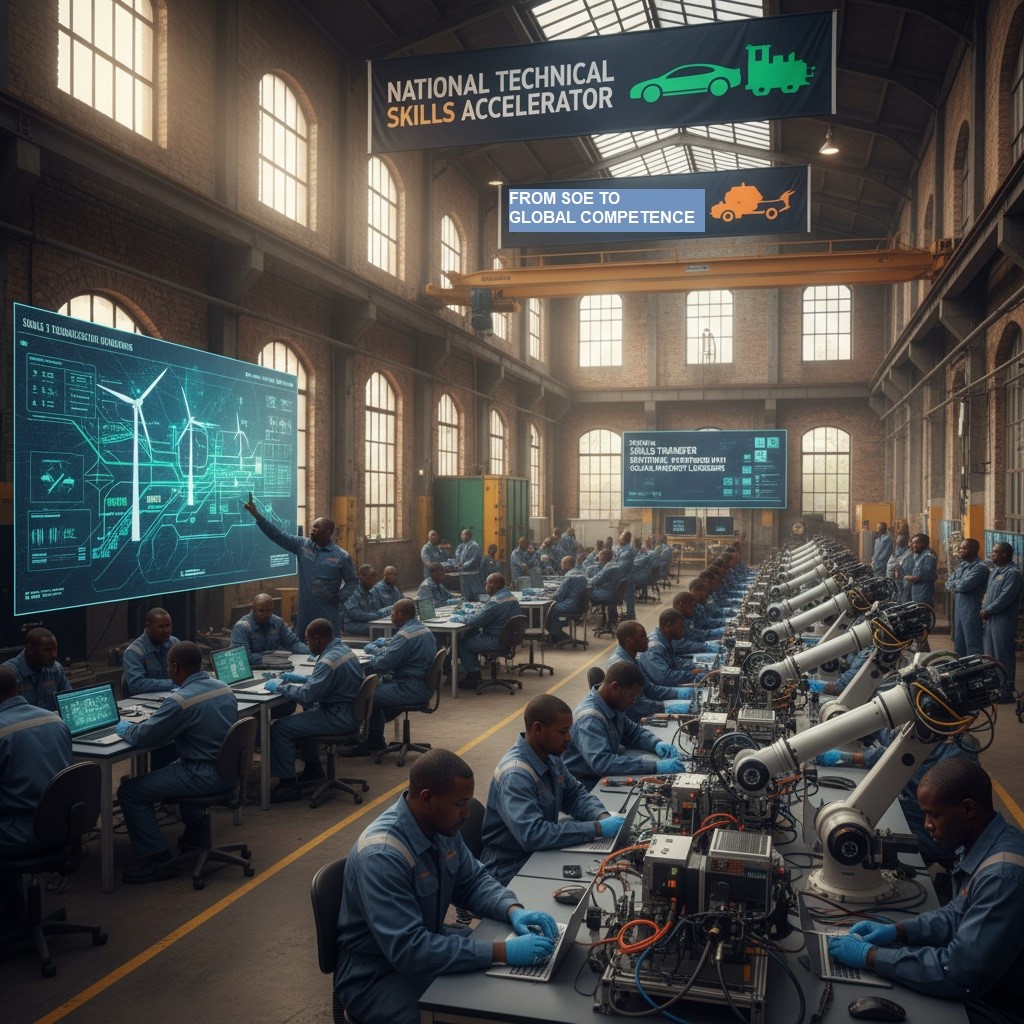
South African companies, in partnership with global industrial leaders, must champion the repurposing of underutilised state assets; specifically, the vast human capital within state-owned enterprises (SOEs) such as Transnet or Eskom. Instead of viewing these individuals as ballast, a National Technical Skills Accelerator (NTSA) could be established. This cross-sectoral, private-sector-managed entity would retrain and certify vast pools of existing technical talent in areas of national shortage, from advanced maintenance engineering to renewable energy systems installation. This provides a direct path for the private sector to absorb a 'shadow labour force,' bypassing the slow, bureaucratic reform of the SOEs themselves. This is not skills development; it is value chain reengineering at a national scale.
Practical Frameworks for South Africa and Beyond: Turning Vision into Institutional Muscle
For South African companies, leadership renewal means building cultures that reward execution, not excuses. Boards must hold executives to measurable delivery, not political patronage. For global corporations entering South Africa, it means creating public-private compacts that bypass paralysis and deliver shared value, such as joint infrastructure investments or skills academies aligned with real labour market needs.
For policymakers worldwide, the South African cautionary tale is clear: unemployment statistics conceal the deeper malaise of failed leadership. Countries that mistake technical unemployment programmes for true reform are only delaying collapse.
The Execution Imperative: A Call to Executive Will
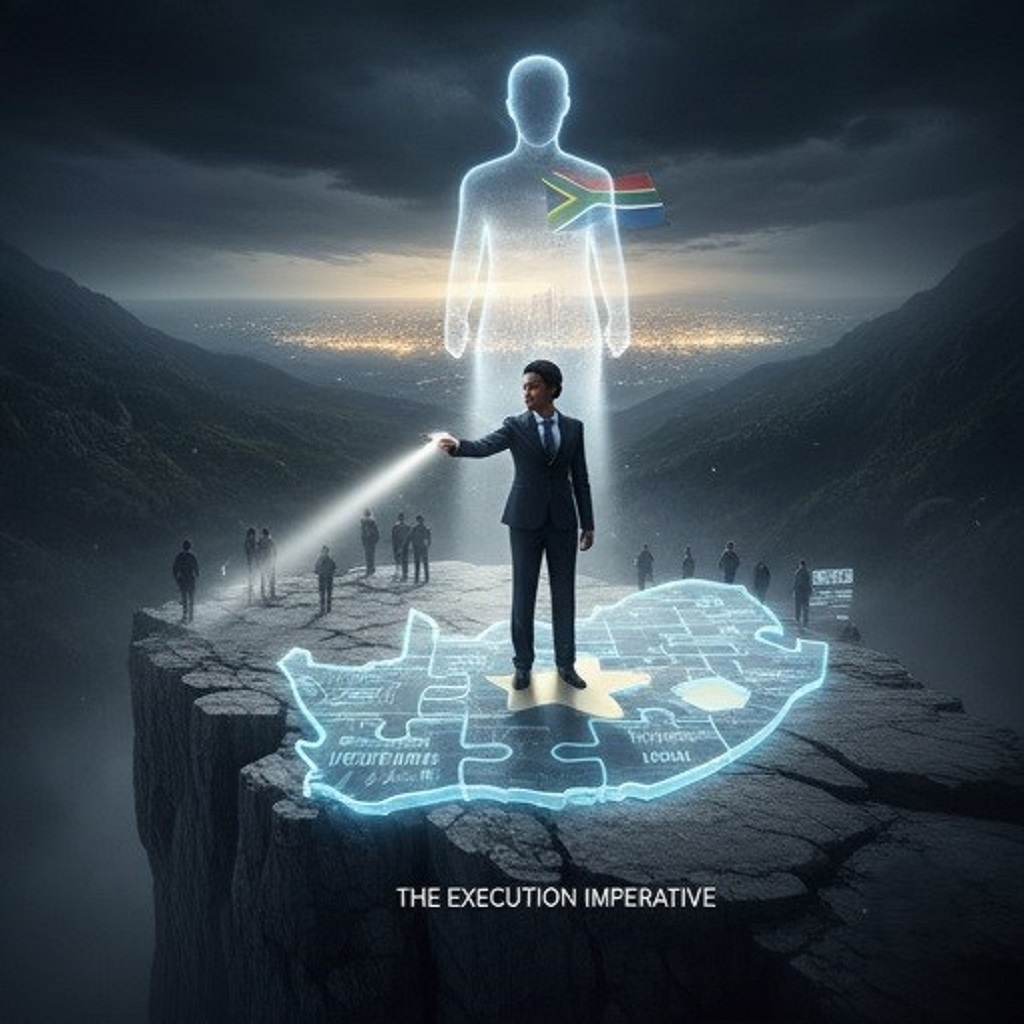
The structural components for prosperity exist. The capital is available. The workforce is willing. The missing component remains the executive intelligence required to fuse these elements into a cohesive, high-performing economic engine. The time for timid incrementalism has passed.
The global elite must cease their passive observation. The time for philanthropic platitudes and superficial impact reports has evaporated. The solution is not in funding another enterprise development scheme; it is in aggressively underwriting the creation of a visionary cadre capable of delivering on the promise of the nation. The ultimate strategic risk is not market volatility; it is the tolerance of mediocrity at the apex of power. The distinction will determine whether South Africa descends further into institutional entropy or ascends to its rightful position as the continent's pivotal economic engine. This requires not merely capital, but the transference of executive will.
The choice, gentlemen, is whether to merely witness history, or to architect it.
Food for Thought: Until Leadership Evolves, Unemployment Will Remain a National Consequence
Until leadership is redefined, reimagined, and reclaimed, unemployment will remain not a problem to be solved, but a consequence to be endured.
And that is the true crisis.
The Final Reckoning: The Line Between Decline and Renewal Is Leadership
So, let us ask the question again: Does South Africa really have an unemployment problem? Or is unemployment merely the smoke, with leadership failure as the fire? The answer is plain. No number of jobs initiatives will succeed until leadership itself is redefined.
And here lies the universal challenge to global leaders: Are you prepared to lead with clarity, courage, and accountability, or will you preside over the decay of your institutions and nations?
The world does not lack jobs. It lacks leaders who can create the conditions for human potential to thrive. South Africa stands as the starkest reminder. The choice is not between unemployment or employment. The choice is between leadership or collapse.
That is the question every leader must answer.
Images by Bandile Ndzishe of Bandzishe Group
About bandile ndzishe

Bandile Ndzishe is the CEO, Founder, and Global Consulting CMO of Bandzishe Group, a premier global consulting firm distinguished for pioneering strategic marketing innovations and driving transformative market solutions worldwide. He holds three business administration degrees: an MBA, a Bachelor of Science in Business Administration, and an Associate of Science in Business Administration.
With over 29 years of hands-on expertise in marketing strategy, Bandile is recognised as a leading authority across the trifecta of Strategic Marketing, Daily Marketing Management, and Digital Marketing. He is also recognised as a prolific growth driver and a seasoned CMO-level marketer.
Bandile has earned a strong reputation for delivering strategic marketing and management services that guarantee measurable business results. His proven ability to drive growth and consistently achieve impactful outcomes has established him as a well-respected figure in the industry.
As an AI-empowered and an AI-powered marketer, I bring two distinct strengths to the table: empowered by AI to achieve my marketing goals more effectively, whilst leveraging AI as a tool to enhance my marketing efforts to deliver the desired growth results. My professional focus resides at the nexus of artificial intelligence and strategic marketing, where I explore the profound and enduring synergy between algorithmic intelligence and market engagement.
Rather than pursuing ephemeral trends, I examine the fundamental tenets of cognitive augmentation within marketing paradigms. I analyse how AI's capacity for predictive analytics, bespoke personalisation, and autonomous optimisation precipitates a transformative evolution in consumer interaction and brand stewardship. By extension, I seek to comprehend the strategic applications of artificial intelligence in empowering human capability and fostering innovation for sustainable societal advancement.
In essence, I explore how AI augments human decision-making in both marketing and other domains of life. This is not merely an interest in technological novelty, but a rigorous investigation into the strategic implications of AI's integration into the contemporary principles of marketing practice and its potential to reshape decision-making frameworks, enhance strategic foresight, and influence outcomes in diverse areas beyond the marketing sphere.