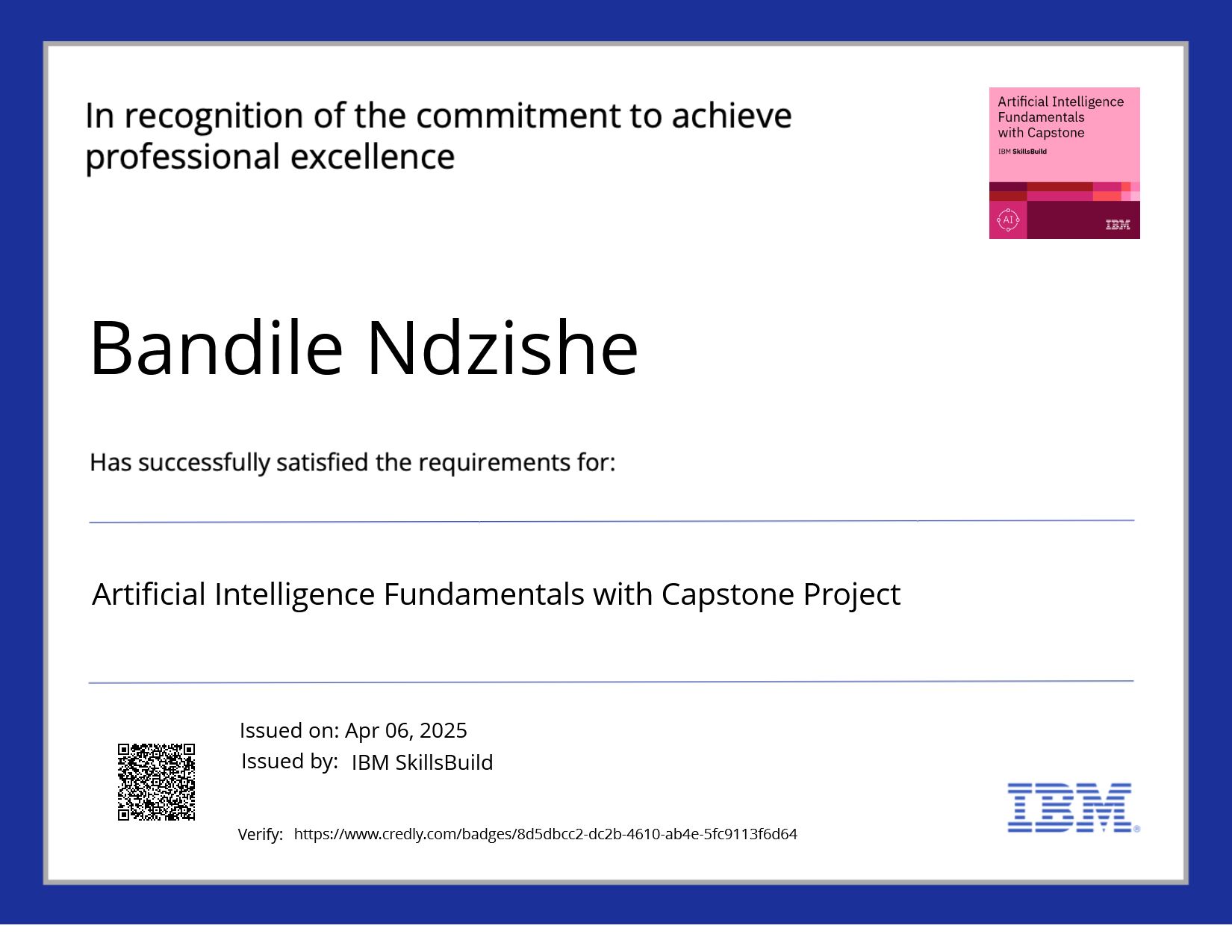

In a world increasingly driven by innovation, artificial intelligence (AI) stands as the beacon of progress, reshaping industries, societies, and economies. My commitment to achieving professional excellence by becoming AI-savvy has been complemented by my pursuit of a professional certification in Artificial Intelligence Fundamentals with Capstone Project through IBM SkillsBuild. This advanced programme enriched my MBA by expanding my expertise in key AI domains, including machine learning, natural language processing, and data-driven decision-making. Successfully executing a capstone project allowed me to apply these principles to real-world challenges, refining my understanding and capabilities further.
Building upon this foundational achievement, my journey through seven meticulously designed AI master classes has forged my expertise, empowering me to deliver unparalleled insights and solutions to businesses, governments, and NGOs worldwide. This intellectual odyssey has equipped me with cutting-edge AI knowledge, a suite of high-level skills, and a vision for how AI can catalyse marketing and strategy to extraordinary heights. I now stand poised to apply AI-powered strategies to revolutionise marketing, optimise operations, and redefine organisational success. Let me unveil the pivotal milestones of this transformative expedition.
Charting the Course of an AI Odyssey: What Does It Mean To Be AI-Savvy in 2025, 2030, and Beyond?
How can AI serve as a multiplier of human ingenuity rather than a mere replacement of human input? The answers lie in a strategic, ethical, and visionary approach to AI. I believe my AI journey reflects precisely that. This was not just an educational endeavour – it was a strategic investment in future relevance. The aim is not just to inform, but to ignite a sense of possibility – and a call to immediate action.
To be AI-savvy in 2025, 2030, and beyond speaks to my ability to offer not just theoretical AI knowledge but a practical understanding of how AI can be strategically deployed to optimise operations, unlock new revenue streams, enhance governmental efficiencies, and address pressing societal challenges. The insights I have gleaned from this rigorous AI masterclass, encompassing fundamental principles, advanced methodologies, ethical considerations, and practical implementation skills, represent a microcosm of the transformative potential that lies dormant within your organisations and our economies.
The fusion of AI with marketing, the advent of AI-Marketing, AI-Empowered Marketing, and AI-Powered Marketing, presents unprecedented opportunities for targeted engagement and amplified impact.
1. Introduction to Artificial Intelligence: Foundations of Limitless and Endless AI-Empowered Possibilities
What is the essence of artificial intelligence? This foundational module unravelled critical AI concepts. I gained the ability to define AI, distinguish it from augmented intelligence, and explain its three tiers – Narrow AI (2010-2015), Broad AI (Currently), and General AI (Arriving around 2050 with possibly the equivalence of human intelligence). Furthermore, there is also Artificial Superintelligence (ASI) arriving near the end of this century. It will be self-aware and will surpass human intelligence in all aspects. I now understand the intricate mechanisms by which AI systems make predictions and uncover hidden connections in data. I acquired a solid grasp of how AI systems process vast swathes of structured and unstructured data to make predictions, detect patterns, and support human decisions. Mastery of these fundamentals allows me to articulate AI’s revolutionary impact, providing clarity amidst the complexity.
This foundational knowledge empowers me to communicate AI's essence and its transformative potential to stakeholders. Imagine a future where AI streamlines governmental processes, improves the delivery of public services, and revolutionises corporate decision-making. South African businesses, in particular, can leverage AI to analyse semi-structured data, enhancing their marketing strategies through data-driven insights. Does your organisation realise the unparalleled competitive advantage AI can offer? These learnings empower me to assist organisations in structuring unstructured data for strategic advantage. By integrating AI tools into marketing strategies, companies can refine consumer segmentation and predict trends with unparalleled accuracy.
Businesses, NGOs, and even governments can now adopt data-driven decision-making frameworks to foster inclusivity, optimise public services, and stimulate economic growth. The question arises: Are we truly harnessing the full potential of the data at our disposal? With AI, the answer can resoundingly become "yes."
This foundational understanding of AI enables me to help businesses differentiate between full automation and augmented intelligence, where AI assists but does not replace humans. For marketing leaders, this is a game changer: Consider AI's capability to sift through unstructured social media conversations to discover emerging customer trends before they go mainstream. Governments can employ similar logic to interpret citizen sentiment and improve public services, while NGOs can use AI to assess programmatic impact in data-scarce environments.
Reflecting on this initial deep dive module, I came to understand that AI is not a monolith defined by singularity – it is a versatile toolkit, equipped to address multifaceted challenges across industries and domains. And when properly understood, it enables leaders to automate the mundane, scale the extraordinary, and redefine what’s possible. I now see how AI can be seamlessly embedded into a marketing strategy – refining customer segmentation, enabling hyper-personalisation, and driving real-time campaign optimisation. AI-empowered marketing begins with understanding the fundamentals of AI, and from there, one can build transformative capabilities. Marketing strategies can now evolve from data-driven to AI-empowered marketing, in which consumer insights are not merely gathered but interpreted, forecasted, and acted upon in real time.
2. Natural Language Processing and Computer Vision: Bridging Human Interaction by Making Sense of Words and Images
How do machines interpret human language and imagery? This module illuminated the inner workings of Natural Language Processing (NLP) and Computer Vision. Through AI algorithms such as Convolutional Neural Networks (CNNs) and Generative Adversarial Networks (GANs), including chatbots, I learned to harness these technologies for diverse applications.
From enabling sophisticated chatbot solutions to automating inspection processes in manufacturing plants, the scope is vast. Chatbots can revolutionise customer service, while Computer Vision can optimise quality control in manufacturing. South African firms can deploy GANs for creative marketing campaigns, from generating lifelike promotional visuals to building customer personas. The question is not whether to adopt these technologies, but rather, can you afford not to?
The competencies I gained in NLP and Computer Vision enable me to guide businesses in deploying advanced chatbots to enrich customer support and to utilise Computer Vision to revolutionise product quality control processes. For instance, a logistics company in South Africa could adopt computer vision systems to identify and rectify flaws in goods before shipment, reducing waste and enhancing client satisfaction. For marketing leaders, these technologies represent a leap forward in personalisation – AI-empowered campaigns can analyse emotions within user-generated content to gauge consumer sentiment dynamically. This interplay of creativity and precision encapsulates the essence of AI-driven marketing innovation.
Why is all this significant for modern enterprises? NLP can power intelligent virtual assistants that handle thousands of customer interactions simultaneously, reducing operational costs and enhancing customer service. In marketing, AI can analyse vast text corpora to uncover sentiment, emerging needs, or even misinformation. For South African companies, think of chatbots that cater to multilingual audiences across 11 official languages, ensuring inclusivity while maintaining efficiency.
In retail, Computer Vision can be used to track shopper engagement with physical and digital merchandising. NGOs can use it to assess infrastructural damage in remote areas through drone-captured imagery.
For me, this module was an epiphany: language and imagery are no longer barriers – they are bridges. And in mastering them, I have learned how to design AI-marketing ecosystems that feel human yet scale exponentially.
3. Machine Learning and Deep Learning: Teaching Machines to Think Like Us is the Architecture of Intelligence
Can machines think and adapt autonomously? Understanding how machines emulate learning processes was a cornerstone of my training. Delving into this module, I explored systems inspired by human neural networks, uncovering the principles of machine learning and deep learning. I mastered techniques such as supervised learning, unsupervised learning, and reinforcement learning, each pivotal for solving diverse business challenges.
Imagine deploying machine learning to forecast market trends with remarkable precision, or a global financial institution leveraging generative AI to streamline fraud detection processes. Organisations can build resilient systems that thrive in uncertainty. For marketers, these technologies are indispensable in creating personalised, data-driven advertising and targeted marketing campaigns driven by predictive AI models, tailored to individual consumer profiles. Is there a boundary to innovation, or are we only limited by imagination?
The implications for marketing are profound. AI-empowered marketing is now predictive, not reactive. Campaigns adjust automatically based on consumer feedback loops. My ability to apply these models ensures not only targeted messaging, but also optimal channel selection and timing, maximising ROI and minimising wastage.
For instance, let us consider the impact of applying reinforcement learning in the realm of supply chain management, enabling real-time adaptability to disruptions. Equally, deep learning’s generative capabilities promise to revolutionise advertising by automating the creation of compelling content tailored to diverse demographics. Could your organisation benefit from harnessing these innovations to amplify reach and resonance? My practical experience enables me to answer this question affirmatively – and to deliver actionable roadmaps to realise these possibilities. Isn't this the holy grail of marketing?
This module reshaped my strategic vision: AI isn’t simply about automation – it’s about anticipation, unlocking proactive decision-making at every level of enterprise.
4. Running AI Models with IBM Watson Studio: Transforming Concepts into Reality

How can we transform AI theory into actionable implementation? This module provided hands-on experience with the sophisticated IBM Watson Studio, where I designed, built, trained, tested, refined, and optimised machine learning models. Through AutoAI, Cloud Object Storage, and Jupyter Notebooks, I gained practical expertise in AI model execution. Watson Studio’s AutoAI function offered a glimpse into the future of no-code AI solutions, making it accessible for organisations without in-house data science expertise.
The practical applications are profound. For instance, NGOs could use AI models to optimise resource allocation for humanitarian efforts, while businesses could employ prediction experiments to fine-tune customer acquisition strategies. Alternatively, multinational corporations could use predictive experiments to refine global market entry strategies. These advanced tools redefine operational strategy, enabling organisations to navigate complexities with precision. Will your business take the leap into AI-enhanced decision-making? With these skills, I can help South African companies unlock value by integrating Watson Studio into their AI arsenal. Is your organisation ready to innovate?
For instance, a South African insurer could use AI models to predict policyholder behaviour and reduce churn, while a global FMCG company might leverage Watson Studio to optimise its supply chain forecasts. Marketing departments can use the same tools to run A/B tests on messaging effectiveness, accelerating decision-making from weeks to hours. It also means the capacity to A/B test messaging strategies through AI-generated personas – AI-marketing becomes intelligent, iterative, and infinitely scalable.
This was the point where AI became real for me – not a theory, but a set of tools to sculpt tomorrow’s market strategies with scientific confidence. With IBM Watson Studio, AI becomes a deployable asset, not a theoretical luxury.
The capacity to rigorously compare multiple model iterations and optimise performance metrics equips me to solve complex business challenges. Consider a South African bank leveraging predictive models to identify high-risk credit applicants, thereby mitigating defaults while extending financial inclusion to underserved populations. My expertise in this area enhances marketing efforts: This same data-driven precision, pivotal in banking, can also revolutionise marketing strategies. AI-powered models can forecast campaign ROI with granularity, driving informed budget allocations and strategic pivots. The question must be posed: If your competitors are already utilising AI to optimise their workflows, can your enterprise afford not to?
5. AI Ethics: Navigating the Labyrinth of Trust by Building Trustworthy Systems in a Distrustful World
Is responsible innovation achievable in AI? Can AI be ethical? Ethics is the compass that ensures AI’s transformative power serves humanity’s best interests. This module guided me through the five pillars of trustworthy AI: Fairness, transparency, robustness, explainability, and accountability. I learned to mitigate AI biases, ensure data privacy, and uphold ethical considerations. I also delved into adversarial attacks, data minimisation, and differential privacy.
How do we ensure that our AI systems do not perpetuate historical injustices or marginalise vulnerable populations? This question must be central to any AI implementation strategy. In marketing, ethical AI ensures that personalisation does not turn into manipulation. For governments, it is about ensuring transparency in algorithmic decision-making, from welfare distribution to criminal justice.
For leaders, ethical AI is not just a necessity but a strategic imperative. Ethical AI practices are paramount for long-term success. South African banks can adopt explainable AI systems to foster customer trust, while global healthcare companies must prioritise data minimisation to protect patient information. Businesses that champion ethical AI will undoubtedly lead in creating socially responsible solutions. Is your business poised to champion responsible innovation?
My insights into adversarial attacks, bias mitigation, and privacy protection enable me to develop ethical frameworks for AI deployment across various sectors. For instance, NGOs combating inequality can leverage fair AI algorithms to ensure equitable access to resources. AI-driven marketing strategies, too, must adhere to ethical norms – bias-free targeting ensures campaigns resonate across diverse audiences while upholding brand integrity. Leaders must ponder: Will ethical lapses undermine the credibility of emerging AI innovations? I am well-prepared to lead organisations toward AI solutions underpinned by robust ethical principles.
6. Your Future in AI: The Job Landscape – Building Tomorrow’s Workforce
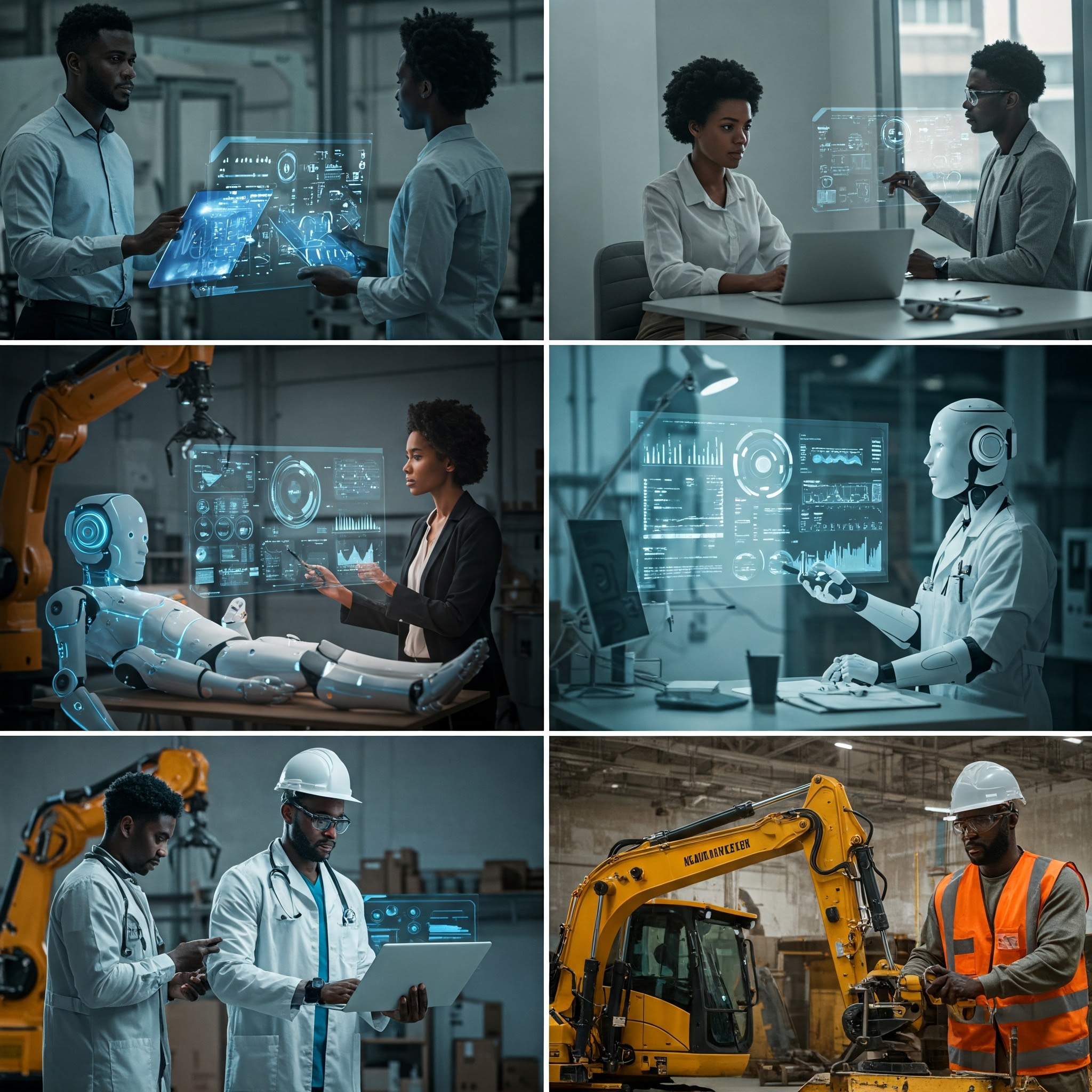
What does the AI workforce of the future look like? This module explored the expanding global demand for AI professionals and the diverse roles within the field, from Data Scientists and AI Practitioners, to AI Ethicists and many more, and the diverse industries that will benefit from this technology. I gained insights into the global job market and the critical skill sets required to thrive in roles such as Chief Data Officer, Director of Data Science, Chief Technology Officer, Chief Privacy Officer, Head of AI, AI Marketing Manager, AI Product Manager, and Machine Learning Engineer.
Where does this leave business leaders? It presents both a challenge and an opportunity. The talent gap is vast, but those who act now to reskill their workforce will have a decisive competitive edge. In South Africa, where youth unemployment is a national crisis, a focus on AI job training can catalyse inclusive economic growth.
For South African enterprises, investing in AI talent is a strategic imperative that can catalyse economic growth, create jobs, and drive prosperity by cultivating home-grown AI expertise. Globally, industries from aerospace engineering to sustainable energy are integrating AI to address their most pressing challenges. How will you ensure your organisation remains competitive in this transformative landscape?
Could my skills in mapping out AI roadmaps help companies ride the crest of this technological wave? Absolutely. As South Africa aspires to cultivate an AI-savvy workforce, I am uniquely placed to bridge talent gaps and guide strategic initiatives that create mass employment and uplift the economy.
Furthermore, as someone well-versed in both marketing and AI, I’m better positioned to serve as a strategic link between technical and non-technical teams. I can translate AI capabilities into strategic marketing plans and identify AI-based tools that boost campaign ROI. This is the dawn of AI-marketing hybrids, and I am ready to lead in this space.
For businesses, this is a call to action: Invest in AI fluency, not just AI products. Hire AI-empowered talent that understands both business context and algorithmic logic. Cultivate internal AI capabilities to reduce dependency on external consultancies. South African universities and companies can partner to establish AI Centres of Excellence, fuelling job creation and economic growth.
This module filled me with both urgency and optimism: The future is AI, and the AI skills I now possess are not only relevant – they are vital.
7. Mastering the Art of Prompting: Unlocking AI’s Full Potential

Can effective communication with AI redefine creativity? This module equipped me with the art of crafting precise and nuanced prompts to communicate with AI language models, elicit sophisticated outputs and unlock their full capabilities. I explored myriad applications, from generating complex marketing strategies and campaigns to designing personalised customer experiences.
These skills empower me to revolutionise content generation processes in marketing, enabling campaigns that resonate with precision and persuasion. A hypothetical scenario: Imagine a multinational beverage company tasking AI-powered systems with crafting multilingual, culturally tailored ads, all guided by well-constructed prompts. My adeptness at prompt refinement ensures that clarity, creativity, and contextual relevance are always at the forefront. Is your enterprise primed to leverage the unparalleled efficiency of AI-augmented content creation? If not, now is the moment to take action.
Imagine leveraging AI-powered marketing to craft bespoke campaigns that resonate deeply with target audiences, or a South African media agency leveraging AI models to create compelling narratives? What about global entertainment firms using AI-driven insights to predict audience preferences? These applications exemplify the power of AI-enabled creativity in driving engagement and innovation. How far can we push the boundaries of human ingenuity when paired with intelligent systems?
The implications are staggering: Imagine a marketing manager co-developing a campaign in real-time with an AI assistant, generating content, testing tone, and refining messages.
For South African startups and big corporation leaders alike, this means the democratisation of creativity. You don’t need a massive creative team; you need strategic prompting. AI-marketing becomes not just data-informed, but co-created, accelerating ideation and innovation cycles.
I emerged from this module convinced: The future will be built by those who speak the language of machines – eloquently, ethically, and strategically.
A Call to Action for Visionary Leaders: A Call to Arms in the Age of AI
As I reflect on this transformative journey, one truth stands illuminated – AI is not merely a tool – it is an epochal shift; it is an enabler of human potential. Through mastery of these seven AI modules, I have armed myself with the knowledge and competencies to not only envision a brighter, AI-empowered future but to build it. I have undergone a full-circle transformation: from theoretical novice to practical implementer, from observer of trends to co-architect of intelligent futures. My competencies are not abstract – they are ready for application.
The pathway to a prosperous future lies in investing in artificial intelligence. As demonstrated through my learning journey, AI offers a wealth of opportunities to enrich industries, drive government efficiencies, elevate economies, create jobs, and foster societal prosperity by creating economic opportunities.
To CEOs, tech visionaries, world leaders, policymakers, and business executives: I challenge you to champion AI skills development within your organisations. Will you seize this opportunity to drive growth, foster innovation, and shape a future defined by intelligent systems? Are you ready to revolutionise your industry, enrich our nation’s economy, and embrace the transformative power of AI? Let’s turn the limitless potential of artificial intelligence into a catalyst for South African economic growth, job creation and African progress.
The time is now to embed AI into your national economic strategies, your corporate structures, and your digital marketing campaigns. Let’s build governments that serve better, businesses that perform smarter, and NGOs that deliver deeper impact.
Invest in AI skills development. Embed AI into your organisational DNA. Create jobs. Drive GDP growth. Champion ethical innovation. The AI economy is here, and it rewards the bold.
Images by Bandile Ndzishe of Bandzishe Group
About bandile ndzishe

Bandile Ndzishe is the CEO, Founder, and Global Consulting CMO of Bandzishe Group, a premier global consulting firm distinguished for pioneering strategic marketing innovations and driving transformative market solutions worldwide. He holds three business administration degrees: an MBA, a Bachelor of Science in Business Administration, and an Associate of Science in Business Administration.
With over 29 years of hands-on expertise in marketing strategy, Bandile is recognised as a leading authority across the trifecta of Strategic Marketing, Daily Marketing Management, and Digital Marketing. He is also recognised as a prolific growth driver and a seasoned CMO-level marketer.
Bandile has earned a strong reputation for delivering strategic marketing and management services that guarantee measurable business results. His proven ability to drive growth and consistently achieve impactful outcomes has established him as a well-respected figure in the industry.
As an AI-empowered and an AI-powered marketer, I bring two distinct strengths to the table: empowered by AI to achieve my marketing goals more effectively, whilst leveraging AI as a tool to enhance my marketing efforts to deliver the desired growth results. My professional focus resides at the nexus of artificial intelligence and strategic marketing, where I explore the profound and enduring synergy between algorithmic intelligence and market engagement.
Rather than pursuing ephemeral trends, I examine the fundamental tenets of cognitive augmentation within marketing paradigms. I analyse how AI's capacity for predictive analytics, bespoke personalisation, and autonomous optimisation precipitates a transformative evolution in consumer interaction and brand stewardship. By extension, I seek to comprehend the strategic applications of artificial intelligence in empowering human capability and fostering innovation for sustainable societal advancement.
In essence, I explore how AI augments human decision-making in both marketing and other domains of life. This is not merely an interest in technological novelty, but a rigorous investigation into the strategic implications of AI's integration into the contemporary principles of marketing practice and its potential to reshape decision-making frameworks, enhance strategic foresight, and influence outcomes in diverse areas beyond the marketing sphere.