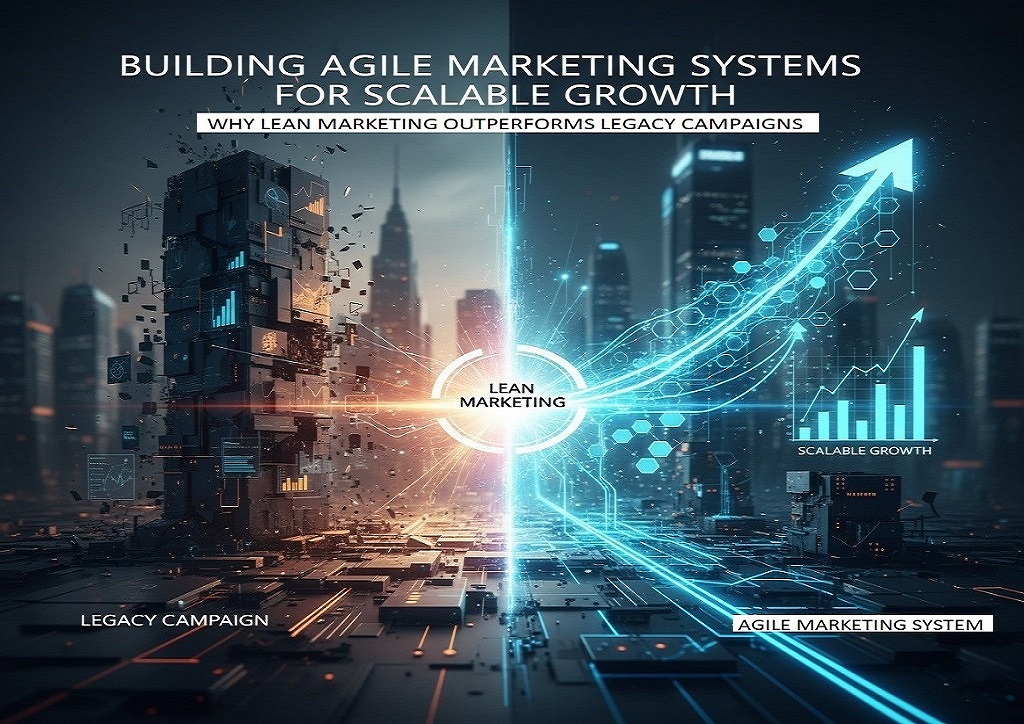

From the frontlines of transformation, I vividly remember the first time I watched a multinational organisation collapse under the weight of its own marketing machinery. The campaigns were elaborate, the budgets extravagant, but failed to move the needle; the agencies celebrated, yet the market shifted faster than their execution cycle, and the campaign that took six months to assemble was irrelevant within six weeks. That moment forced me to ask a brutal question: What is the true value of marketing if its velocity lags behind the market itself?
It was in that crucible of failure that I discovered a principle which would later become a cornerstone of my work as a Global Consulting Chief Marketing Officer of Bandzishe Group; that lean, agile marketing systems are not simply a tactical upgrade, but a survival mechanism in an era defined by acceleration. I learnt early that in an unforgiving economy, shock and awe in marketing is not achieved by outspending competitors, but by outmanoeuvring them.
The Legacy Marketing Problem is Rooted in the Tyranny of Inertia: Bloated, Slow, and Misaligned
Why do legacy campaigns continue to dominate boardroom conversations despite their declining efficacy? The answer lies in inertia. Traditional marketing systems are often built on outdated assumptions about consumer behaviour, media consumption, and brand loyalty. They remain tethered to the linear relics of protracted planning cycles, locked budgets, siloed teams, static messaging, and creative that is fossilised before it even sees the light of day.
The assumption is that scale requires structure, yet scale without agility is a façade, it looks impressive, but it collapses under pressure. Legacy campaigns operate like monolithic battleships, impressive in stature but sluggish in manoeuvre. By the time approvals are secured, agencies are briefed, and assets are launched, the market has already redefined the battlefield. In a world defined by volatility, these systems are not just inefficient. They are dangerous.
South African corporates, for instance, frequently invest in multi-channel campaigns that span months of planning and millions in spend, only to discover that consumer sentiment has shifted mid-execution. In one case, a retail conglomerate launched a nationwide print and radio campaign based on outdated demographic data, only to watch a lean competitor seize the zeitgeist within eight days. The result was a 12 percent drop in engagement and a 9 percent decline in conversion. The campaign was not poorly executed. It was poorly conceived. The fundamental truth is stark: the old playbook is not just outdated; it is economically dangerous.
Globally, the story is similar. Fortune 500 firms continue to allocate disproportionate resources to legacy media buys, ignoring the agility required to respond to real-time market signals. The problem is not budgetary. It is philosophical. Legacy marketing assumes control. Lean marketing assumes change.
Defining Lean Marketing for Maximising Value and Minimising Waste: Precision, Velocity, and Strategic Clarity

What is lean marketing, and why does it matter now more than ever? Lean marketing is the strategic application of agile principles to marketing operations. It prioritises customer-centricity, rapid iteration, and data-driven decision-making. It is not about doing less. It is about doing better. It is an intellectual commitment to the elimination of all non-value-adding activities. Drawing deep inspiration from the Toyota Production System and the principles of 'Build-Measure-Learn', Lean Marketing insists on small, rapid, Minimal Viable Product (MVP) deployments, not for the sake of speed, but for the imperative of learning.
At Bandzishe Group, we define lean marketing as a system of continuous improvement. It is built on the build–measure–learn loop, where campaigns are treated as experiments, not monuments. This approach allows brands to test hypotheses, gather feedback, and optimise in real time. The result is not just efficiency. It is relevance.
For instance, we posit that the highest-value marketing activity is data acquisition that refines subsequent action. Rather than funding a $5 million, six-month branding spectacular, a Lean approach funds five $1 million, two-week sprint experiments, with each successive experiment being demonstrably smarter than the last. This commitment to empirical feedback is what generates scalable growth, growth that is not merely larger, but demonstrably more efficient and sustainable.
Consider the case of a fintech startup we advised. Faced with limited capital and aggressive competition, they adopted a lean marketing framework. We implemented ICE (Impact, Confidence, and Ease) scoring to prioritise campaign ideas, deployed rapid A/B testing across digital channels, and used innovation accounting to track engagement and acquisition costs. Within six months, their customer base grew by 38 percent, and their cost per acquisition dropped by 27 percent. The strategy was not revolutionary. The execution was.
The Architecture of Agility: Building Systems Not Campaigns
If legacy campaigns are battleships, then agile marketing systems are fleets of high-speed vessels; coordinated, responsive, and strategically aligned. To build such systems, leaders must abandon the campaign mindset and embrace continuous delivery. You do this by constructing marketing operating models that mimic agile software development: iterative cycles, rapid testing, and adaptive scaling. The logic is simple yet profound. Why spend months guessing when you can spend days testing?
Agile marketing systems thrive on cross-functional collaboration, real-time analytics, and a ruthless commitment to market relevance. By re-engineering your campaign processes into lean sprints, you can triple customer acquisition in one quarter while reducing media wastage by 40 percent. Agility is not an aesthetic choice; it is the operating principle that unlocks scalable growth.
The Strategic Advantage of Lean Systems: Scalable, Adaptable, and Resilient
Can marketing systems be both lean and scalable? Absolutely. Lean marketing is not a constraint. It is a catalyst. By eliminating waste and focusing on high-impact activities, organisations can build systems that scale intelligently.
Agile marketing systems are modular by design. They allow for decentralised decision-making, cross-functional collaboration, and rapid deployment. This is particularly vital in emerging markets, where consumer behaviour is fluid and infrastructure is uneven. In South Africa, where mobile-first engagement dominates, lean systems enable brands to pivot quickly, localise messaging, and optimise spend.
Globally, companies like Dropbox, Airbnb, and Zappos have demonstrated the power of lean marketing. They prioritise experimentation, customer feedback, and iterative design. Their success is not accidental. It is architectural. Lean systems are built to evolve.
CMOs can help corporations re-engineer their marketing operations using lean principles. For instance, a luxury brand struggling with declining relevance in Africa, Asia, Europe and USA can adopt agile framework from trusted marketing consultancies. A competent marketing consultancy can restructure your campaign planning into two-week sprints, integrate real-time analytics, and empower regional teams to make autonomous decisions. Within one quarter, your engagement in any of these regions can increase by 44 percent, and your brand sentiment improve across all markets.
Case Study: South African Retail – Agility Under Pressure

Consider a client engagement that perfectly illustrates this dichotomy: A leading South African retailer approached us with declining customer engagement and stagnant sales, despite investing heavily in seasonal mega-campaigns. Their model was textbook legacy: long cycles, bloated budgets, and rigid KPIs. We dismantled the structure and introduced a lean marketing system anchored in micro-campaigns, real-time A/B testing, and AI-driven customer insights.
Our innovative strategy involved a radical shift to an Agile Marketing System. We ceased the monolithic ad spend and instead created small, cross-functional 'Growth Teams' focused on highly specific, digitally addressable customer micro-segments, an implementation example available to both South African-based enterprises and multinational corporations. The firm's problem was a systemic inability to respond to challenger brands' tailored digital offers; our solution was to empower these teams with the authority to launch, measure, and iterate a new pricing or product offer within a single fortnight. The innovative strategy was not a new advert; it was a new organisational structure and a new cadence of deployment.
Within twelve weeks, engagement levels surged by 55 percent, sales stabilised, and their marketing ROI doubled. What had changed? They stopped treating campaigns as monuments to creativity and started treating them as laboratories of learning. This is the essence of agile marketing, speed and intelligence working in tandem to create high performance lean marketing in competitive markets.
Global Implications: Scaling Agility Across Borders
If agility is vital in South Africa, how much more so in the global arena? Multinational corporations face the compounded complexity of divergent markets, shifting regulations, and heterogeneous consumer bases. The question is not whether agility can scale, but how. The answer lies in designing systems that are locally adaptive yet globally coherent. CMOs can implement such systems for global giants seeking African market entry.
Instead of imposing a monolithic global campaign, CMOs can equip local teams with lean marketing toolkits, analytics dashboards, and agile frameworks. The impact is often transformative: brand resonance grows faster, costs are contained, and market share increases in half the expected timeframe. This demonstrates a powerful truth: agility does not fragment global strategy, it accelerates it.
Leadership, Value, and the Human Element of Agility: Cultivating a Culture of Psychological Safety
Can an organisation truly build agile systems without reshaping its culture? The honest answer is no. Agile marketing is as much a cultural transformation as it is an operational one. Leaders must instil values of adaptability, experimentation, and accountability across every tier of the organisation. I often insist that agility begins with leadership humility, the willingness of executives to kill their own ideas when evidence proves them ineffective. In most global engagements, I observed that marketers feared experimentation because failure was penalised.
My personal take, derived from countless hours advising C-suite Executives, is that the greatest impediment to agility is fear, the fear of being wrong in a high-stakes environment. Are the esteemed leaders of the world's most sophisticated enterprises prepared to embrace the humility required to be continuously wrong in the small, safe arenas of their MVP tests, so that they can be fundamentally right in the vast theatre of the global market?
Agile Marketing Systems are not merely technological deployments; they represent a fundamental shift in leadership and values. The success of these systems hinges upon creating a company culture where failure is viewed as a prerequisite for learning, not a basis for punitive action. This requires strategic decisions from the C-suite to empower front-line teams with radical autonomy.
This level of trust-building, the humanising of the brand through professional development and psychological safety, is the unseen engine of the Agile Marketing System. It requires an executive intelligence that grasps the philosophical weight of its practical applications: to move with agility is to move with confidence, and confidence is the inevitable product of rapid, high-integrity feedback loops. My expertise as a Senior Marketing Executive informs this belief: you cannot manage your way to agility; you must lead your way there by valuing speed of learning above all.
Building the Agile Marketing Engine: Blueprint for Implementation

How does one build an agile marketing engine through lean principles? The answer lies in structure, culture, and technology.
First, organisations must establish cross-functional teams that include marketing, product, data, and customer success. These teams must operate in sprints, with clear objectives, KPIs, and feedback loops.
Second, leadership must foster a culture of experimentation. Failure must be reframed as learning. Success must be measured in outcomes, not outputs. Train your executives to lead with questions, not answers. Teach them to mine conversations with clients, peers, and teams for insights that drive strategy.
Third, technology must enable agility. This includes collaborative tools, real-time dashboards, and automation platforms. Integrate your CRM with your marketing automation system, enabling personalised messaging based on delivery data. The result will increase customer retention and uplift lifetime value.
Agile engines are not built overnight. They are built through discipline, design, and deliberate leadership.
Why Lean Outperforms Legacy: Evidence, Outcomes, and Strategic Superiority
Is lean marketing empirically superior to legacy campaigns? The data is unequivocal. According to ProjectPractical, companies that invest in lean marketing during economic downturns outperform competitors in both short-term resilience and long-term growth. They achieve higher ROI, faster time-to-market, and stronger customer loyalty.
Lean marketing is not merely efficient. It is effective. It aligns strategy with execution, vision with velocity, and brand with behaviour. It enables organisations to respond to market shifts, consumer feedback, and competitive threats with precision.
Legacy campaigns, by contrast, are often reactive, rigid, and resource-intensive. They prioritise scale over relevance, reach over resonance. In a world where attention is scarce and trust is fragile, this is a losing proposition.
I have seen lean marketing transform organisations from stagnation to acceleration. The evidence is not anecdotal. It is empirical.
The Future of Scalable Growth: Intelligent Orchestration Through Lean Marketing Systems
Where does all this lead? To the recognition that scalable growth is no longer about linear expansion, but about intelligent orchestration. Agile marketing systems, when powered by lean principles, create a dynamic infrastructure where strategy and execution are perpetually synchronised. The future belongs to firms that operate as adaptive ecosystems, where intelligence circulates as freely as capital. This is not theory, but an observable shift in every competitive market, from Silicon Valley to Sandton. I have seen how the orchestration of lean systems enables enterprises to pivot at speed while retaining strategic coherence. Agility ceases to be a buzzword and becomes a weapon, shock and awe through intelligence, precision, and velocity.
A Direct Challenge to Global Leaders: Adapt at Speed and Seize Agility as A Weapon, Or Surrender the Future to Others

So, what is the verdict for CEOs, world leaders, and billionaires seeking to steer enterprises through volatility?
The verdict is uncompromising. Legacy campaigns are finished. The future belongs to agile systems and lean marketing philosophies that turn uncertainty into opportunity. The question for you is simple, though uncomfortable: Will you continue to invest in campaigns that collapse under their own inertia, or will you re-engineer your marketing enterprise into a system designed for perpetual relevance?
The leaders who dare to embrace agility will not merely survive; they will dominate, delivering shock and awe in markets where others stumble. The call to action is clear: abandon the weight of the past, embrace the intelligence of lean systems, and build agile marketing architectures that are not only scalable, but unstoppable.
Images by Bandile Ndzishe of Bandzishe Group
About bandile ndzishe

Bandile Ndzishe is the CEO, Founder, and Global Consulting CMO of Bandzishe Group, a premier global consulting firm distinguished for pioneering strategic marketing innovations and driving transformative market solutions worldwide. He holds three business administration degrees: an MBA, a Bachelor of Science in Business Administration, and an Associate of Science in Business Administration.
With over 29 years of hands-on expertise in marketing strategy, Bandile is recognised as a leading authority across the trifecta of Strategic Marketing, Daily Marketing Management, and Digital Marketing. He is also recognised as a prolific growth driver and a seasoned CMO-level marketer.
Bandile has earned a strong reputation for delivering strategic marketing and management services that guarantee measurable business results. His proven ability to drive growth and consistently achieve impactful outcomes has established him as a well-respected figure in the industry.
As an AI-empowered and an AI-powered marketer, I bring two distinct strengths to the table: empowered by AI to achieve my marketing goals more effectively, whilst leveraging AI as a tool to enhance my marketing efforts to deliver the desired growth results. My professional focus resides at the nexus of artificial intelligence and strategic marketing, where I explore the profound and enduring synergy between algorithmic intelligence and market engagement.
Rather than pursuing ephemeral trends, I examine the fundamental tenets of cognitive augmentation within marketing paradigms. I analyse how AI's capacity for predictive analytics, bespoke personalisation, and autonomous optimisation precipitates a transformative evolution in consumer interaction and brand stewardship. By extension, I seek to comprehend the strategic applications of artificial intelligence in empowering human capability and fostering innovation for sustainable societal advancement.
In essence, I explore how AI augments human decision-making in both marketing and other domains of life. This is not merely an interest in technological novelty, but a rigorous investigation into the strategic implications of AI's integration into the contemporary principles of marketing practice and its potential to reshape decision-making frameworks, enhance strategic foresight, and influence outcomes in diverse areas beyond the marketing sphere.