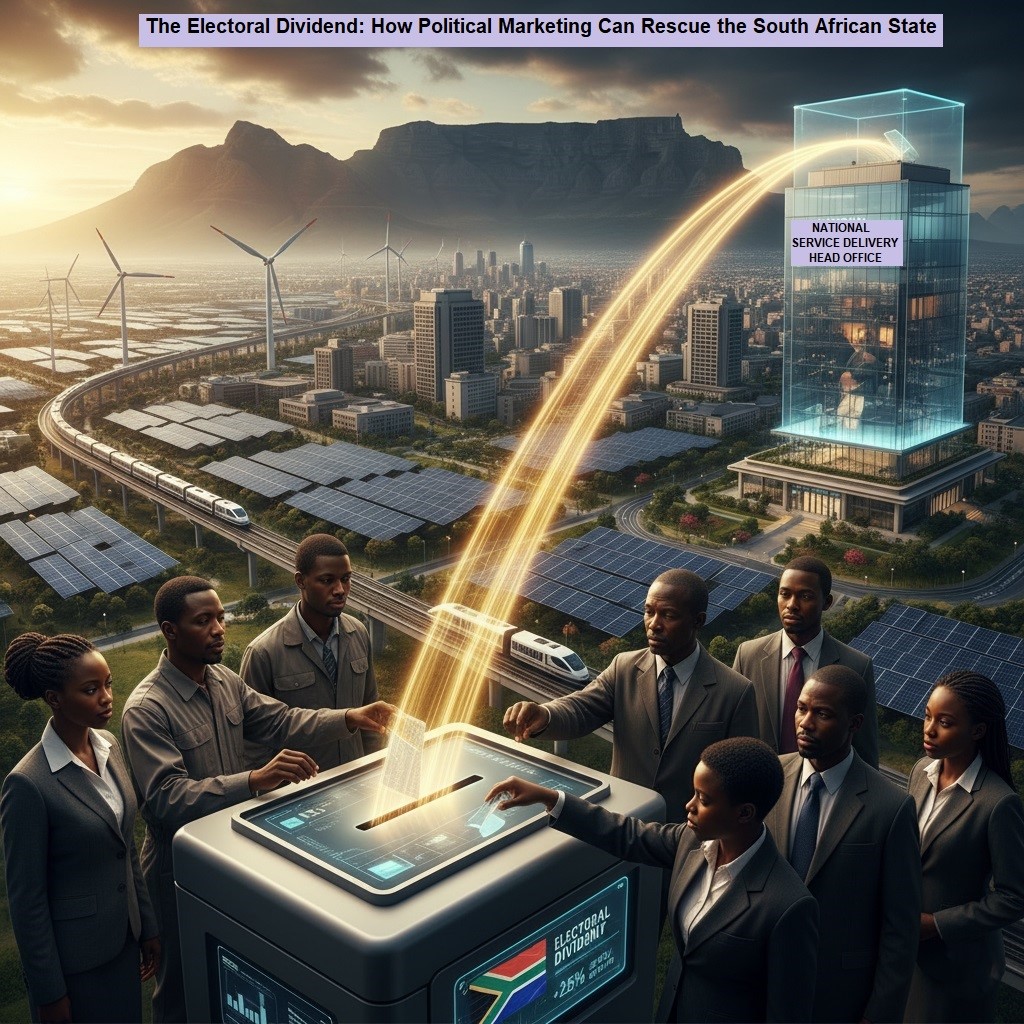

There comes a moment in every nation’s history when its democracy must be audited. It happens when democracy becomes a non-performing asset. South Africa stands precisely at that threshold. A nation votes, the ballots are cast, yet nothing moves. Citizens vote, but they do not receive. Why? Political parties campaign, but they often fail to deliver. The slogans are exhausted, and yet the nation’s institutions perform like a once-great company whose management has lost touch with its customers. The citizens remain loyal shareholders in a republic that frequently yields no dividends.
The crisis is not ideological. It is structural. The republic is not broken. It is misaligned. What if the problem is not political incapacity but the absence of political marketing intelligence? What if the rescue and salvation of the South African state depends not on new policy frameworks but on the strategic discipline of Political Marketing applied as a science of governance?
Political Marketing, properly institutionalised, is not a campaign accessory. It is a sovereign instrument of statecraft. It is the missing link between electoral mandate and service delivery. It is the mechanism by which the electoral dividend is realised.
In the corporate world, brands that fail to deliver value are restructured, repositioned, or removed. Governments, however, rarely submit themselves to such rigour. Political Marketing, accurately institutionalised, offers a managerial revolution: it translates citizen sentiment into actionable intelligence, it replaces propaganda with service logic, and it converts political theatre into performance accountability.
The concept of the Electoral Dividend demands that democracy, like any investment, must generate measurable returns. The vote is not the end of engagement but the beginning of a service contract between the citizen and the state.
The Abyss of Failed Delivery: A Sovereign Risk Reimagined for Guaranteed Service Delivery Success
The democratic project in South Africa, a nation once the very apotheosis of political redemption, now faces a crisis of utility, a structural entropy that demands immediate and radical intervention. Are we witnessing merely a cyclical downturn in public administration, or the terminal collapse of the social contract itself, a disintegration of institutional credibility that poses an unquantifiable sovereign risk to the entire African market?
The conventional remedies of fiscal austerity and anti-corruption task teams, whilst necessary, have proven insufficient, addressing symptoms while the core pathology, the fatal disconnect between electoral input and governmental output, metastasises. This treatise posits a challenging, proprietary solution: the uncompromising institutionalisation of Political Marketing, not as mere electoral puffery, but as a sophisticated instrument of statecraft designed to re-engineer public trust and realise the elusive Electoral Dividend.
This is not a thesis on sentiment; it is a blueprint for institutional survival, leveraging advanced behavioural science to convert abstract political mandates into tangible, performance-driven governance. The failure to deliver has transformed the state into a depreciating asset, yet every point of failure, when viewed through the lens of high-level marketing intelligence, represents a spectacular, untapped conversion opportunity for the astute political architect.
Defining Political Marketing: An Applied Science of Governance and A Strategic Instrument of Democratic Service Delivery
Political marketing, in its most rigorous and institutionalised form, is the strategic application of commercial marketing principles to the political domain, not for the purpose of persuasion alone, but for the orchestration of democratic alignment. It is the science of understanding voter needs, voter behaviour, the art of crafting resonant political narratives, the discipline of designing governance as a service experience and the mechanism for excellent and unsurpassed service delivery.
This discipline is fundamentally about identifying, satisfying through service delivery, and perpetually retaining the 'customer' (the citizen) through the delivery of high-quality, branded public 'products' (policies and services), thereby generating the necessary political capital for sustained governance. It is the mechanism that translates citizen desire into governmental imperative, ensuring that public policy is not designed in an administrative vacuum but is dynamically responsive to articulated market needs and service gaps.
Far beyond slogans and campaign optics, political marketing encompasses market research, segmentation, targeting, positioning, brand management, product branding, consumer behaviour analysis, and strategic communication, directly applied to the operation and performance of the sovereign state, political parties, government departments, and public policy.
In the context of South Africa’s democratic fatigue, political marketing must be reimagined not as electoral theatre, but as a sovereign instrument of statecraft: capable of restoring trust, recalibrating expectations, and converting democratic participation into tangible service delivery. The objective is to rewire the state's operating model, moving it from a passive, monopolistic bureaucracy to a competitive, responsive entity whose legitimacy is earned daily through measurable, communicated service excellence, thereby making the political brand inherently valuable and trustworthy. The true power of political marketing lies in its capacity to institutionalise a perpetual feedback loop, converting citizen dissatisfaction into actionable product development and ultimately securing the invaluable Electoral Dividend.
Political marketing treats governance as a living brand system, one in which every department, decision, and communiqué either strengthens or fractures the national covenant. It is the science of alignment. It repositions citizens not as passive recipients of state benevolence and ideology, but as active consumers of governance and discerning customers of national value. It reframes politics as a marketplace of credibility, where authenticity, responsiveness, and reliability define competitive advantage. Properly understood, it becomes the managerial logic of democracy, a continuous feedback loop that links voter psychology, government performance, and institutional reputation into a unified system of accountability.
The Electoral Dividend Defined: Democracy as a Performance Contract

The electoral dividend is the return on democratic investment. It is the tangible benefit a citizen receives for participating in the political process. In South Africa, this dividend has been diluted. Political marketing can restore it by aligning expectations with delivery, rewiring the feedback loop between citizen and state, and transforming voting from ritual into transaction.
This is not manipulation. It is precision. It is the science of relevance. It is the art of alignment. When citizens perceive value in their vote, they vote with purpose. When they do not, they disengage. Political marketing is the mechanism by which purpose is restored.
India’s Aadhaar programme offers a compelling example. It used marketing intelligence to onboard over a billion citizens into a digital identity system. It converted bureaucracy into accessibility. It treated citizens as clients. South Africa must adopt similar strategies. It must use marketing to convert policy into experience.
“It’s the Economy, Stupid”: Political Marketing as the Strategic Multiplier of Economic Renewal
The well-known and widely used American political catchphrase "It’s the economy, stupid", originally coined by James Carville during Bill Clinton's 1992 presidential campaign, serves as a brutally efficient maxim. It asserts that for any government, regardless of its ideological orientation or foreign policy successes, the singular, decisive factor in its electoral survival and public legitimacy is the tangible economic well-being of its citizens. It underscores the reality that voters, regardless of race and philosophical persuasion, respond most viscerally to economic outcomes: jobs, economic growth, and financial security. This concept, devoid of its American colloquialism, translates into a fundamental strategic reality: a state's political brand is ultimately valued by its own electorate, and on the world stage, by the strength of its fiscal performance and its capacity to generate prosperity.
In essence, the catchphrase "It’s the economy, stupid" captures an enduring truth: that citizens measure leadership not by rhetoric, but by the prosperity it generates. In the South African context, this principle demands reinterpretation as a national strategic doctrine of economic communication and confidence-building. How, then, does the discipline of political marketing, traditionally focused on image and persuasion, become the engine of economic development and stability?
Political marketing, properly institutionalised, functions as an economic catalyst because it restores coherence between public expectation and state delivery. When government messaging aligns with credible economic action, investor sentiment stabilises, consumer confidence rises, and the trust premium returns to the marketplace. Every improvement in political credibility lowers the perceived risk of investment, thereby attracting capital, stimulating enterprise formation, and enlarging the tax base. When citizens believe in the credibility of the state, they are more likely to engage economically, to spend, to start businesses, to hire, et cetera.
Moreover, political marketing can reframe unemployment not merely as a statistical burden, but as a solvable design challenge. Campaigns must showcase job creation strategies with clarity, urgency, and emotional resonance. Municipalities must brand themselves as opportunity zones. Government ministries must position themselves as engines of growth. The ripple effect is profound: trust breeds participation, participation breeds productivity, and productivity breeds prosperity. Political marketing is not a distraction from economic reform. It is its delivery mechanism.
From Slogan to System: Political Marketing as the Architecture of State Renewal
Political marketing is often trivialised as the art of persuasion before elections. This is an intellectual disservice. At its highest form, it is the science of aligning institutional capacity with public value. It requires the same rigour that global corporations apply to understanding their markets, segmenting audiences, managing brands, and designing experiences. In the absence of this marketing intelligence, the state communicates in monologue, not dialogue, and service delivery collapses under the weight of its own tone-deafness.
Reimagine the state as a conglomerate of service brands, each with its own promise, value proposition, and accountability metrics. Energy is not a ministry; it is a reliability brand. Health is not an expenditure line; it is a care brand. Education is not a bureaucratic function; it is a promise of social mobility. Political marketing converts these abstractions into tangible service identities, governed by data, informed by citizen insight, and measured by trust. The South African state does not lack ambition; it lacks market alignment. The citizens are no longer a passive electorate; they are discerning consumers of governance.
Global precedents abound. In Singapore, the government deploys sophisticated citizen analytics to track satisfaction with public services, adjusting delivery models accordingly. In Estonia, digital government platforms operate as continuous engagement funnels, not occasional points of contact. The United Kingdom’s Behavioural Insights Team, known as the “Nudge Unit”, transformed policy implementation through data-driven psychology. Each of these nations treated governance as a marketplace of expectations and loyalty, not as a monopoly of authority. South Africa must do the same if it intends to rescue its republic from inertia.
Voter Psychology as Strategic Capital: Rewiring the Democratic Transaction
In commercial marketing, the consumer is sovereign. Brands compete not merely for attention, but for loyalty. In political marketing, the voter must be treated with equal reverence. This requires segmentation, targeting, and positioning. The electorate is not a monolith. It is a mosaic of needs, aspirations, and grievances. Political parties must cease broadcasting and begin narrowcasting. They must speak to the voter’s pain, not the party’s pride.
Consider the youth vote. Unemployment among South Africans aged 15 to 34 stands at over 43 percent. This is not merely a statistic. It is a strategic opportunity. Political marketing can reframe this despair into agency. Campaigns must offer not platitudes, but pathways. They must convert grievance into engagement. They must treat the voter not as a spectator, but as a stakeholder.
Globally, Barack Obama’s 2008 campaign remains the gold standard. It did not merely mobilise voters. It activated identities. It used data, narrative, and behavioural insight to convert apathy into action. South African parties must learn from this. They must stop selling ideology and start selling outcomes.
Pain Points as Portals and Market Gaps: Converting Crisis into Marketing Opportunity
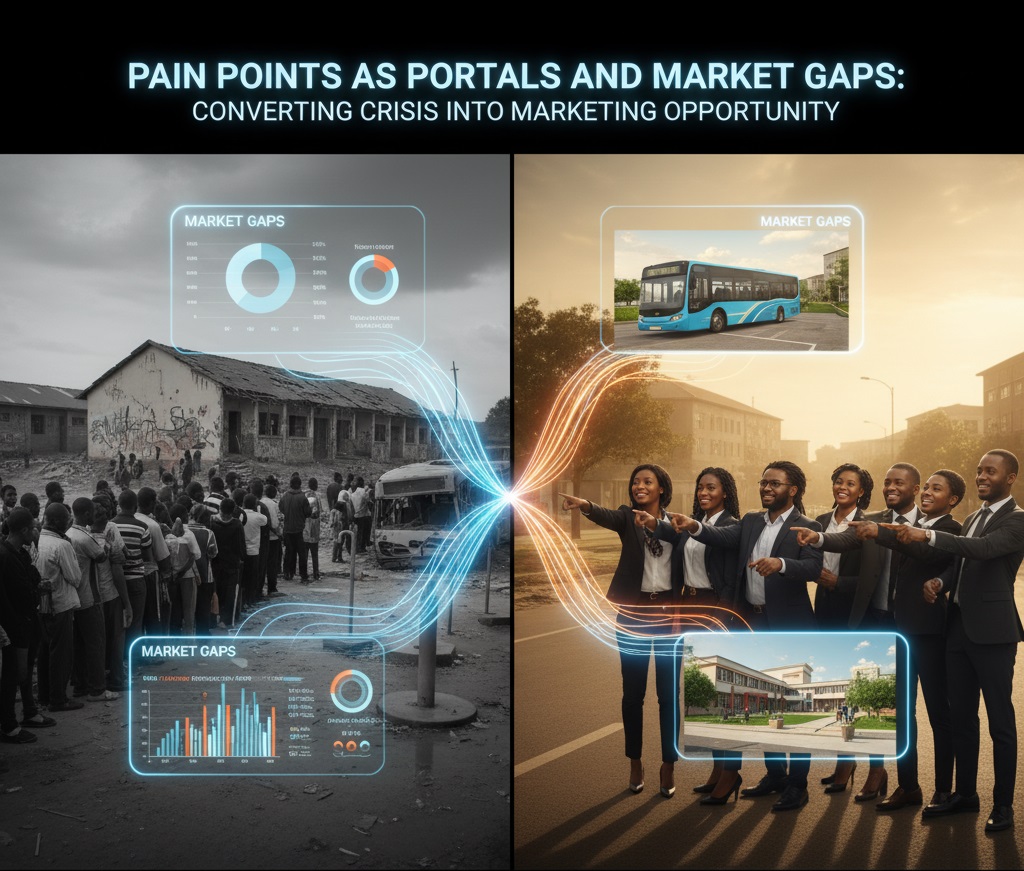
Every national failure conceals a marketing insight waiting to be mined. How can a state, possessed of immense mineral wealth and robust democratic architecture, systematically fail its primary mandate of service provision, thereby eroding the very legitimacy of its existence? The problem lies in the misidentification of the core relationship: the citizen is not a passive subject, but an active, demanding consumer of state services, having already paid a premium, their vote and their tax contribution, for a guaranteed return. Loadshedding, the devastating collapse of electricity supply, which is now called load reduction, is fundamentally a branding problem of reliability, comparable to a blue-chip utility company repeatedly failing to maintain its core product promise to its most valuable customers. The solution is not merely engineering; it is the implementation of a proactive, segmented communication strategy, akin to the crisis management protocols deployed by global giants such as BP or Toyota during catastrophic product failures, designed to demonstrate transparent accountability, scheduled repair, and demonstrable future-proofing.
Municipal dysfunction, including the ubiquitous decay of local infrastructure, is not only an administrative problem; it is a failure of customer experience and a complete breakdown of the state's micro-transactional touchpoints with its citizens. Potholes, refuse accumulation, and water interruptions constitute broken service touchpoints. Political marketing would demand that every municipality adopt a citizen experience management system, where feedback loops inform resource allocation in real time. This requires the wholesale adoption of enterprise resource planning and customer relationship management systems from global innovators like SAP or Salesforce, translating citizen complaints into quantifiable service tickets with guaranteed response and resolution timelines, transforming a bureaucratic black hole into a responsive, high-performance service ecosystem. For instance, the Western Cape’s municipal service dashboards, which publicly track delivery metrics, already demonstrate how marketing transparency can translate into public trust.
Corruption fatigue, the most pervasive and corrosive of South Africa’s maladies, is a profound loss and collapse of brand trust. It is a betrayal of the state’s fiduciary duty that necessitates a radical, almost surgical reputational repair. In marketing terms, trust is the most expensive asset to rebuild once lost. Corporations like Johnson & Johnson, which survived crises through radical transparency and ethical responsiveness, offer a blueprint. Political marketing would insist on branding integrity as a measurable performance indicator for public institutions. The state’s ethics narrative must be communicated as a premium brand proposition, not as a compliance afterthought.
Unemployment, often treated as an economic statistic, must be reframed as a failure of national customer acquisition. The youth are not statistics; they are untapped markets of talent. A marketing-intelligent state would segment these citizens by skill potential, design targeted employment experiences, and communicate opportunity pipelines. Rwanda’s national talent registry, which integrates youth profiling with investment attraction, demonstrates how political marketing principles can turn policy into participation.
The Marketing Mandate: Institutionalising Behavioural Statecraft
To realise the Electoral Dividend, political marketing must transition from an ad hoc campaign function to a core, institutional pillar of governance, a mandatory discipline within every government department. Can we genuinely expect sustained performance when the electoral reward mechanisms remain entirely divorced from measurable service delivery outcomes, operating on the shifting sands of political personality and historical allegiance?
The current South African model operates on a principle of democratic input without requiring market output, creating a systemic moral hazard where parties can win elections despite demonstrable administrative dereliction. The solution is to introduce performance-based marketing intelligence, a sophisticated feedback loop that perpetually monitors citizen sentiment, service consumption patterns, and policy impact in real-time, moving beyond crude five-year election cycles. This demands the deployment of advanced data analytics and psychometrics, tools routinely employed by C-suite executives at entities such as Tesco or Amazon, to segment the electorate not merely by demographics, but by their service consumption profiles and brand loyalty to government initiatives. This permits the strategic allocation of resources to high-impact interventions that maximise the Electoral Dividend, guaranteeing that policy execution directly corresponds to the public’s most acute needs, thereby creating a powerful, virtuous cycle of delivery and re-endorsement.
For South African companies, this offers a unique opportunity for private-sector co-creation, leveraging their internal marketing and data science capabilities to consult on government re-engineering, transforming a public problem into a lucrative B2G consulting market.
The Strategy of Commercialised Governance: A New Social Contract
The new political marketing strategy must articulate a social contract framed in the unromantic, yet powerfully effective, language of commerce: the citizen is the shareholder, the government the management, and the vote the investment. What, precisely, is the quantifiable return on democratic participation, and how is that dividend communicated, managed, and guaranteed to the shareholder-citizen? This involves a revolutionary application of product management principles to public policy, treating every government initiative, from housing to education, as a defined, branded, and auditable product with specific service level agreements and clear performance indicators.
Consider the operational discipline of a global corporation launching a new product. Before release, it conducts extensive market testing, defines a compelling value proposition, and guarantees after-sales support. These are not optional gestures. They are strategic imperatives. Now transpose that logic to public housing, a service infinitely more consequential than any consumer electronic. Should the delivery of essential shelter not be governed by the same rigour, the same accountability, and the same responsiveness? Political marketing demands that government treat citizens not as passive recipients, but as discerning clients. Housing is not merely infrastructure. It is a promise. And promises, like products, must be delivered with precision.
The implementation solution for South Africa lies in establishing a Chief Marketing Officer for the State, a cabinet-level position with the executive authority to mandate the adoption of unified, brand-consistent service charters across all departments. Furthermore, Global Corporations operating in South Africa, such as General Electric or Vodacom, must be incentivised to second their top C-suite talent into these governmental CMO roles, embedding a high-performance, market-driven culture directly into the heart of the bureaucracy. This radical approach transforms the state’s narrative from one of entitlement to one of relentless, performance-driven service, making good governance a measurable, communicated, and monetised product.
The Global Parallel: Political Marketing as Governance Intelligence

Globally, the intersection of marketing science and statecraft is reshaping governance. In the United States, the Obama campaign of 2008 transformed voter mobilisation through data analytics, integrating behavioural science with digital engagement. In New Zealand, the government’s “Wellbeing Budget” communicated economic strategy through the language of citizen value, effectively marketing fiscal policy as social investment. These cases illustrate that the boundaries between politics and marketing are dissolving.
South Africa, however, lags in institutionalising this intelligence. The nation’s democracy is mature, yet its marketing of governance remains adolescent. Political marketing must therefore be elevated from campaign headquarters to cabinet rooms. It should be taught not as public relations but as strategic management. Universities, think tanks, and policy schools must embed it within public administration curricula. The time has come for South Africa to lead in defining political marketing not as an instrument of persuasion but as a science of performance.
Political Parties as Service Designers: Prototyping the Future, Not Promising It
Political parties must evolve from ideological vessels into service design consultancies. Their role is not to promise change, but to prototype it. This demands policy labs, narrative engineering, and digital campaigning. Voters should be treated as co-creators, not spectators.
Corruption is not merely a legal issue. It is a brand trust crisis. When political actors are perceived as self-serving, the party’s brand equity collapses. Political marketing must rebuild this trust. It must use transparency, storytelling, and behavioural nudges to reposition integrity as a competitive advantage.
The DA’s “Know Your DA” campaign attempted this. It used narrative to reframe the party’s history. It was not universally successful, but it was structurally sound. It understood that voters do not vote for facts. They vote for stories. Political marketing must master this art.
Globally, Emmanuel Macron’s En Marche movement exemplifies this shift. It did not emerge from ideology. It emerged from design. It used citizen feedback, digital tools, and agile strategy to build a political brand from scratch. South African parties must learn from this. They must stop defending legacy and start designing relevance.
The Three Frontiers of Application: Voters, Government, and Parties

Political marketing must operate across three strategic frontiers if the state is to yield its electoral dividend.
First, voter psychology: The electorate must be understood not through polling, but through psychographic intelligence. Voters no longer respond to ideological appeals but to performance narratives. In the corporate world, Tesla did not sell cars; it sold belonging to a movement. Political parties that understand this psychology can transform disengaged citizens into loyal advocates. Data-driven micro-targeting, when applied ethically, allows campaigns to connect policy promises to personal aspirations.
Second, government departments: Political marketing must be institutionalised as a governance framework. Each ministry should possess an insight function that tracks citizen satisfaction, brand performance, and communication alignment. Service delivery should be governed by the same marketing discipline that global service giants such as Singapore Airlines or Apple apply to customer experience. The South African Revenue Service once demonstrated this capacity; its brand equity derived not from coercion but from efficiency and professionalism. That example should be replicated across the state apparatus.
Third, political parties: Parties must recognise that their product is not ideology but performance credibility. Campaigns should not promise change; they should promise management. In 1997, Tony Blair’s Labour Party rebranded itself through a disciplined message of competence, efficiency, and modernity, delivering a landslide victory. South Africa’s parties can emulate this model by translating their manifestos into measurable delivery pledges, reported quarterly to the electorate. In doing so, political marketing becomes the interface between aspiration and accountability.
Re-engineering the Machinery: From Policy Failure to Performance Brand
The South African state is trapped in a paradox. It is rich in vision documents, strategies, and five-year plans, yet poor in execution and communication. The gap between policy and performance is not intellectual; it is managerial. Political marketing provides the missing bridge. By embedding marketing logic within public institutions, it transforms governance from an administrative command structure into a responsive enterprise.
Imagine a cabinet that functions like a corporate board, where each minister is a brand custodian responsible for delivery metrics, customer feedback, and performance reporting.
Imagine a civil service whose appraisal system measures satisfaction as rigorously as compliance. Imagine annual “citizen reports” replacing distant policy briefings, written in the language of value creation rather than bureaucratic self-justification. These are not fantasies; they are operational principles already evident in high-performing states and corporations.
Companies such as Unilever, which align social purpose with business performance, demonstrate how marketing can turn corporate responsibility into a competitive advantage. A government that aligns policy purpose with marketing precision can achieve the same. It is not populism; it is professionalism in its highest form.
Government Departments as Brands: Repositioning the State as a Service Provider
Every government department must operate as a brand. Not a logo, but a promise. The Department of Health must not merely exist. It must communicate. It must listen. It must deliver. Marketing, in this context, is not spin. It is accountability. It is the architecture of trust.
Loadshedding is not merely an energy crisis. It is a branding failure. Eskom has become synonymous with unreliability. Political marketing can reframe this. It can reposition energy provision as a reliability promise. It can convert outrage into expectation. It can build a brand that delivers, not deflects.
Municipal failure is not merely administrative. It is experiential. Citizens do not interact with policy. They interact with the service. When potholes remain unfilled, when water runs dry, when refuse piles up, the citizens’ experience of the state deteriorates. Political marketing must treat these failures as customer experience breakdowns. It must design service recovery strategies. It must build feedback loops, service charters, and performance dashboards.
Singapore offers a compelling case study. Its government operates with brand discipline. Agencies are evaluated not merely on policy, but on delivery. Citizens are treated as clients. The result is not perfection, but credibility. South Africa must follow suit.
Government-Centric Implementation Blueprint: Ten Strategic Instruments for Realising the Electoral Dividend

This list below, whilst illustrative, does not constitute the exhaustive inventory of instruments necessary for realising the Electoral Dividend. It also does not reflect the full set of items shown in the image above. I can be engaged to explore supplementary, high-impact strategies and the comprehensive requisite set of actions.
1. Citizen Relationship Management (CRM) Systems: Engineering Trust Through Data-Driven Engagement
Government must cease treating citizens as faceless constituents and begin managing them as strategic stakeholders. A political CRM system enables departments to track citizen interactions, preferences, grievances, and service histories. This is not surveillance. It is service intelligence. By building relational databases that capture behavioural insights, ministries can personalise communication, anticipate needs, and respond with precision. The citizen becomes a known entity, not a statistical abstraction. Trust is not declared. It is engineered.
2. Service Charters with Measurable Delivery Promises: Codifying Accountability as a Public Contract
Every department must publish a service charter — a formal declaration of deliverables, timelines, and performance standards. These charters must be binding, not aspirational. They must be audited, not ignored. Citizens must know what to expect, when to expect it, and how to escalate when expectations are breached. This transforms governance from discretionary benevolence into contractual obligation. It converts public service into public certainty.
3. Behavioural Data for Personalised Public Communication: Speaking to Citizens, Not at Them
Mass messaging is obsolete. Citizens are not a crowd. They are a constellation of identities, behaviours, and expectations. Government must deploy behavioural analytics to segment audiences and tailor communication accordingly. Pensioners require reassurance. Youth require opportunity. Entrepreneurs require clarity. Political marketing enables ministries to speak with relevance, not rhetoric. It is the difference between broadcasting and connecting.
4. Policy Labs for Governance Prototyping: Designing Solutions Before Declaring Them
Policy must be prototyped before it is legislated. Government must establish policy labs: agile, interdisciplinary units that test ideas in controlled environments before scaling them nationally. These labs should include civil servants, academics, technologists, and citizens. They must operate with design thinking, rapid iteration, and empirical validation. This is not experimentation. It is responsible innovation. It is the architecture of credible reform.
5. Reframing Service Failures as Customer Experience Breakdowns: Diagnosing Governance Through the Lens of the Citizen
When a citizen encounters a pothole, a power outage, or a delayed grant, they are not experiencing policy failure. They are experiencing a customer experience breakdown. The government must adopt the lexicon and methodology of service design. It must map citizen journeys, identify pain points, and deploy corrective interventions. This reframing shifts the focus from bureaucratic defence to experiential improvement. It is not about fixing systems. It is about fixing experiences.
6. Narrative Engineering for Institutional Repositioning: Crafting the Story of a Credible State
The state must tell its story. Not through propaganda, but through narrative intelligence. Political marketing enables the government to craft compelling, coherent, and credible narratives that explain policy, justify reform, and inspire confidence. These narratives must be rooted in truth, structured with clarity, and delivered with emotional resonance. Citizens do not engage with spreadsheets. They engage with stories. The state must become a storyteller of consequence.
7. Digital Listening Posts for Real-Time Sentiment Analysis: Hearing the Nation Before It Screams
Government must establish digital listening posts: platforms that monitor public sentiment across social media, forums, and feedback channels. These systems must use natural language processing and sentiment analytics to detect emerging concerns, misinformation, and emotional trends. This is not surveillance. It is strategic empathy. By listening before reacting, the government can pre-empt crises, refine messaging, and demonstrate responsiveness. Silence is not absence. It is a signal. The state must learn to hear it.
8. Performance Dashboards for Public Visibility: Making Delivery Transparent and Trackable
Citizens must be able to see what the government is doing, not merely hear what it claims. Performance dashboards: digital platforms that display real-time metrics of service delivery, must be deployed across departments. These dashboards should include key performance indicators, delivery timelines, budget utilisation, and citizen satisfaction scores. They must be accessible, intelligible, and regularly updated. Transparency is not a virtue. It is a strategy.
9. Strategic Branding of Government Departments: Building Institutional Identity and Public Confidence
Each department must operate as a brand, with a clear identity, defined values, and consistent messaging. Branding is not decoration. It is differentiation. The Department of Home Affairs must be known for efficiency. The Department of Health must be known for compassion. The Department of Education must be known for excellence. Political marketing enables the government to build these identities with discipline, design, and delivery. A branded state is a trusted state.
10. Citizen Co-Creation Platforms: Inviting the Public to Design the Republic
Government must move from consultation to co-creation. Citizens must be invited to participate in the design of policies, services, and reforms. Digital platforms, town halls, and participatory budgeting mechanisms must be institutionalised. This is not populism. It is a democratic design. When citizens co-create, they co-own. When they co-own, they defend. Political marketing transforms the citizen from a recipient into a partner. The republic becomes a shared project, not a distant promise.
The Redemption of Democracy: Delivering the True Electoral Dividend

What is the purpose of a vote that yields no value? The question is uncomfortable precisely because it is essential. Democracy cannot survive on ritual alone; it must deliver outcomes that improve life. The electoral dividend represents that outcome. It is the return on the citizen’s faith investment. Political marketing is the operational mechanism through which that dividend is realised, by ensuring that every vote translates into measurable service, every policy into perceptible progress, every government into a credible brand.
The South African state has the infrastructure, the intellect, and the institutional memory to achieve this transformation. What it lacks is marketing intelligence; the disciplined understanding of its citizens as customers of governance. When that intelligence is restored, trust will return, performance will improve, and democracy will once again yield value.
Call to Action: From Political Performance to Political Excellence
South Africa’s future will not be determined by ideology but by intelligence. The time has come for its leaders, strategists, and policymakers to re-engineer governance as a value-creation enterprise. Political marketing is not a luxury of campaigns; it is the architecture of competence. It is the strategic discipline that can restore national credibility, reignite citizen trust, and convert democracy from an event into an experience.
To the lawmakers, policymakers, and intellectuals who shape nations: the lesson is universal. Where politics fails, marketing rescues. Where trust erodes, marketing rebuilds. Where systems decay, marketing reinvents. The true dividend of democracy is not in the counting of votes, but in the delivery of value. The question, therefore, is not whether South Africa can afford to apply political marketing, but whether it can survive without it.
Political Marketing, reimagined as a science of service to the citizen, is the architecture through which South Africa can rise again. The dividend of democracy is not a vote counted, but a life improved. Political Marketing is the intelligence that ensures the first leads to the second.
Images by Bandile Ndzishe of Bandzishe Group
About bandile ndzishe

Bandile Ndzishe is the CEO, Founder, and Global Consulting CMO of Bandzishe Group, a premier global consulting firm distinguished for pioneering strategic marketing innovations and driving transformative market solutions worldwide. He holds three business administration degrees: an MBA, a Bachelor of Science in Business Administration, and an Associate of Science in Business Administration.
With over 30 years of hands-on expertise in marketing strategy, Bandile is recognised as a leading authority across the trifecta of Strategic Marketing, Daily Marketing Management, and Digital Marketing. He is also recognised as a prolific growth driver and a seasoned CMO-level marketer.
Bandile has earned a strong reputation for delivering strategic marketing and management services that guarantee measurable business results. His proven ability to drive growth and consistently achieve impactful outcomes has established him as a well-respected figure in the industry.
As an AI-empowered and an AI-powered marketer, I bring two distinct strengths to the table: empowered by AI to achieve my marketing goals more effectively, whilst leveraging AI as a tool to enhance my marketing efforts to deliver the desired growth results. My professional focus resides at the nexus of artificial intelligence and strategic marketing, where I explore the profound and enduring synergy between algorithmic intelligence and market engagement.
Rather than pursuing ephemeral trends, I examine the fundamental tenets of cognitive augmentation within marketing paradigms. I analyse how AI's capacity for predictive analytics, bespoke personalisation, and autonomous optimisation precipitates a transformative evolution in consumer interaction and brand stewardship. By extension, I seek to comprehend the strategic applications of artificial intelligence in empowering human capability and fostering innovation for sustainable societal advancement.
In essence, I explore how AI augments human decision-making and strategic problem-solving in both marketing and other domains of life. This is not merely an interest in technological novelty, but a rigorous investigation into the strategic implications of AI's integration into the contemporary principles of marketing practice and its potential to reshape decision-making frameworks, rearchitect strategic problem-solving paradigms, enhance strategic foresight, and influence outcomes in diverse areas beyond the marketing sphere.