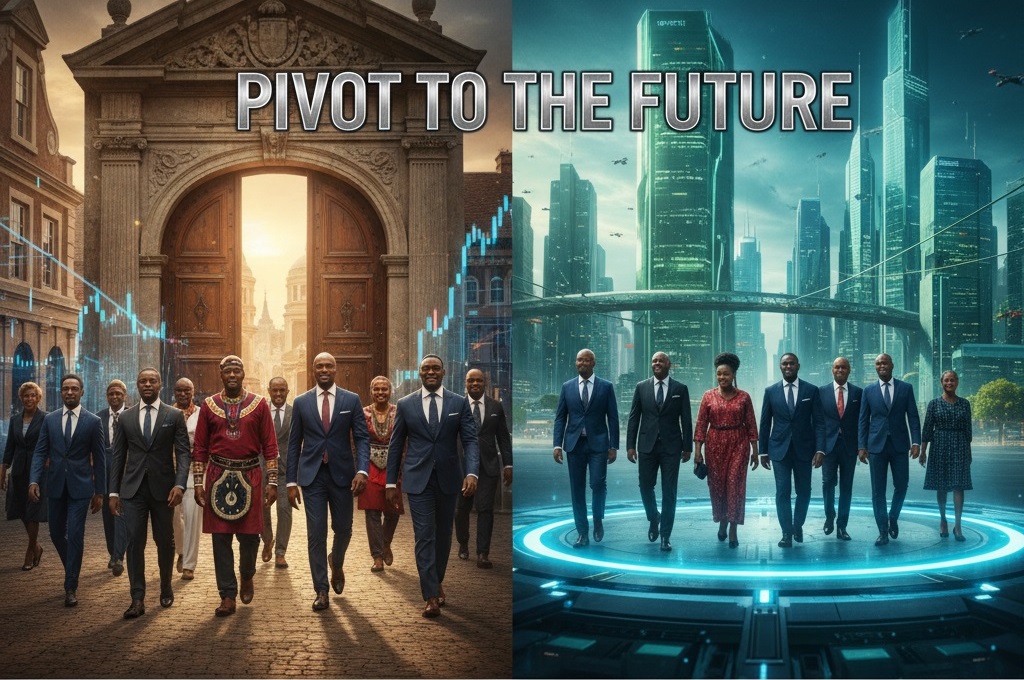

What if the very systems that built your empire are now the greatest threat to its survival? What if the legacy you once protected must now be dismantled, reimagined, and reengineered to remain relevant? What if I were to tell you that within the next decade, a majority of firms currently dominating their sectors may find themselves irrelevant, not because of a lack of ambition, but because of a lack of reinvention? These are not philosophical musings. They are operational imperatives of corporate continuity, buttressed by rigorous quantitative analysis and extensive proprietary research across myriad industries, demanding a level of intellectual energy and confidence that few executives yet possess.
The unvarnished truth, the formidable reality that must be confronted by every chief executive, world leader, and capital architect, is infinitely more brutal: Survival mandates perpetual, aggressive self-cannibalisation.
In Pivot to the Future (2019), Omar Abbosh, Paul Nunes, and Larry Downes deliver a strategic doctrine for navigating the age of perpetual disruption. This is not a book for marketers. It is a manifesto for global CEOs, sovereign wealth architects, and high-tech lords who understand that the future is not a destination, but a discipline. The authors do not offer platitudes. They offer a replicable framework: the “Wise Pivot”. It is not a metaphor. It is a methodology. It demands that leaders simultaneously optimise legacy operations, scale current capabilities, and invest in future innovations. This tri-vector strategy is not merely elegant. It is essential. The pace of technological change has outstripped the rhythm of corporate adaptation. Those who fail to pivot wisely will not fade slowly. They will collapse suddenly.
Accordingly, the seminal work, Pivot to the Future, arrives not as a gentle counsel for incremental change, but as a definitive, high-velocity blueprint for this existential corporate reinvention. Through its central catalytic thesis, Wise Pivot, the book offers a replicable, systematic strategy of simultaneous investment in the core business, acceleration of current growth engines, and aggressive incubation of entirely novel ventures. This is a compelling framework for strategic reinvention and sustained organisational relevance. The core insight is that the challenge is not simply adopting technology, but mastering a dual-speed operating model that preserves the profitable 'old' whilst scaling the disruptive 'new', thereby liberating the substantial trapped value within legacy systems to fuel future prosperity.
Beyond a Book Review – A Strategic Briefing for Global Leaders: Why This Book Caught My Attention and Demands Yours
This book seized my attention because it does not whisper. It roars. It speaks directly to the boardroom, not the classroom. It challenges the orthodoxy of linear transformation and replaces it with a dynamic model of reinvention. From the inception, the authors establish that business reinvention cannot be episodic. In an era defined by artificial intelligence, 5G connectivity, quantum computing and pervasive digital platforms, the classical transformation playbook is obsolete.
Specifically, what captured my attention – and why it should demand yours – is the concept of the wise pivot, a strategic framework designed explicitly for the C-suite elite to harness rather than fear disruption. The “wise pivot” is not a slogan. It is a strategic operating system. It demands intellectual rigour, commercial courage, and organisational agility. The authors base their thesis on a rigorous multiyear study of thousands of companies across thirty industries. As someone who serves in the highest echelons of marketing strategy and digital ecosystems, I perceived in this framework the blueprint to elevate legacy operations into growth engines rather than liabilities.
Why should this matter to you? Because the tectonic plates of global commerce are shifting. South African conglomerates, from mining giants to financial institutions, are grappling with legacy infrastructures that no longer serve their strategic ambitions. Globally, firms like Microsoft, Alibaba, and Siemens have demonstrated that reinvention is not a campaign. It is a culture. This book provides the blueprint.
The Reframing of Operational History: Legacy as Asset, Not Liability

One of the most salient themes in the book is the reframing of legacy systems and capabilities. A pernicious myth permeates the c-suite: that legacy operations represent a fundamental and inevitable anchor, slowing the pursuit of digital nirvana. This book masterfully dismantles that self-defeating proposition. The authors reject the simplistic notion that legacy systems are dead weight. Instead, they counsel and argue for their strategic revaluation. Legacy operations contain embedded customer trust, institutional memory, and operational resilience. Therefore, they should be reimagined. When combined with emerging innovation, legacy becomes the bedrock of transformation.
For clarity, the authors illustrate how corporations such as Accenture itself leveraged this approach, repurposing its core business while investing in five digital growth vectors to double its market capitalisation in five years. Another example is General Electric, which has restructured its industrial legacy into a data-driven services model. Legacy is not the enemy. Mismanagement of legacy is.
In the South African context, a comparable example may be drawn from the manner in which traditional retailers in the Cape Town region integrate in-store legacy merchandising capabilities with e-commerce fulfilment and analytics, preserving brand equity while unlocking new online channels.
Furthermore, legacy systems are the vital foundation upon which audacious innovation must be erected. Where is the wisdom in immolating institutional knowledge and a proven revenue stream simply to conform to the prevailing winds of Silicon Valley ideology? The wiser, more difficult path involves a meticulous transformation of the entrenched systems, the ‘old’ business, from an organisational albatross into a strategic funder of the ‘new’. This necessitates a level of analytical fluency across the executive tier that transcends mere technical appreciation and enters the realm of deep, data-driven financial engineering, effectively teaching an aged behemoth to dance with the agility of a start-up.
Consider the South African banking sector: firms such as Standard Bank, FNB and Nedbank have successfully leveraged their immense customer base and regulatory infrastructure, their legacy assets, not by wholesale demolition, but by launching distinct, digitally-native services, using the historical brand trust as a springboard rather than an impediment. Their solutions involve ring-fencing innovation units with separate governance, allowing them to rapidly iterate customer-centric digital products like the FNB app while the core banking system continues to operate as the engine of liquidity and compliance.
Innovation as Architectural Discipline: Beyond Spontaneous Genius
The prevalent romanticisation of innovation as the spontaneous outburst of eccentric brilliance is a dangerous indulgence for any firm seeking systemic, scalable growth. Pivot to the Future repositions innovation as a disciplined, measurable, and architecturally governed pursuit, a fundamental, non-negotiable operational capability. What purpose is served by cultivating sporadic genius if the organisation lacks the operational plumbing to industrialise its successful outcomes and scale them to market significance?
The authors advocate for a clear innovation architecture that defines the governance models, the ring-fenced funding mechanisms, and the crucial cultural norms that legitimise controlled experimentation and calculated failure. For global corporations, this manifests in the implementation of a rigorous portfolio management approach, whereby investments are systematically distributed across the 'old' (optimising efficiency), the 'now' (accelerating current growth), and the 'new' (disruptive ventures).
Mercedes-Benz, for instance, did not simply wait for electric disruption; it created a separate, heavily funded electric vehicle unit, EQ, thereby institutionalising future innovation and preventing it from being suffocated by the daily exigencies of the core combustion engine business. The practical solution for any Fortune 500 entity lies in establishing an explicit percentage of operational expenditure, say 15 per cent, that is mandated to be allocated to horizon-three technologies, governed by venture capital metrics rather than traditional profit and loss accountancy.
Amazon’s two-pizza team model also exemplifies this proposed innovation architecture approach of governance models, funding protocols, and cultural norms as well. Moreover, technology giants such as Dell Technologies endorse the notion that innovation is a long-term game requiring repeated pivots, not a one-off programme.
In South Africa, Capitec Bank stands as a compelling case study in structured innovation, having redefined retail banking through simplified digital platforms that drive behavioural change and unlock commercial value. Capitec’s strategic focus on user-centric design, transparent pricing, and mobile-first services has not only disrupted traditional banking models but also reshaped consumer expectations across income segments. By eliminating complexity and leveraging behavioural insights, such as incentivising digital adoption and financial literacy, the bank has achieved remarkable growth, particularly among previously underserved populations. Its success illustrates how disciplined innovation, when anchored in customer behaviour, can yield both social impact and sustained profitability.
For a South African multinational energy firm, this might translate into a dedicated “innovation fund” seeded with liberated cash from legacy operations, tasked with supporting pilot projects in renewables and digital energy services, governed by clear stage-gate criteria, and measured by metrics such as customer lifetime value uplift and speed to market.
The Imperative of Analytical Ascendancy: Data Science and Analytical Fluency as Foundational Capabilities

Data is no longer a by-product. It is the product. The modern organisation’s most undervalued asset is not its physical plant or its patents, but the vast, unstructured ocean of data it generates; the inability to harvest, analyse, and monetise this flow is tantamount to leaving a trillion-dollar endowment fallow. The authors correctly identify the ascendancy of data science as a foundational capability, insisting that organisations must cultivate profound analytical fluency not just at the technical layer, but across every strategic leadership tier. The philosophical provocation here is stark: can one truly claim strategic oversight if one cannot interpret the probability distribution of a market shift or the causal relationship between a user interface change and a key performance indicator? The answer, unequivocally, is no.
Leaders must possess the intellectual courage to discard intuition where it conflicts with predictive modelling. The data-driven decision-making espoused by the book is exemplified by Netflix, whose entire content creation and distribution strategy is an algorithmically-driven feedback loop, reducing the inherent risk in creative ventures by basing decisions on behavioural insights and viewing pattern data.
In the South African context, mobile payment platforms are demonstrating this principle by leveraging transaction data to create personalised financial products for the previously unbanked, a powerful socio-economic application of analytical ascendancy that drives both corporate value and national inclusion.
One illustrative example: a South African financial services company might apply advanced customer segmentation and predictive analytics to legacy savings accounts, extract insights on cross-selling digital investment products, and thereby free up funding from traditional operations to invest in fintech innovations.
Leaders who build “analytical leadership” are those who integrate data into every strategic decision, rather than treating analytics as a separate function. The future belongs to those who can interpret it.
Customer-Centric Transformation: Elevating Experience from Tactical to Strategic
Customer experience is not a department. It is a doctrine. The book elevates experience design to a strategic imperative. This is not about UX. It is about value orchestration. Customer experience must be elevated from a marketing concern to a strategic imperative. Experience-led reinvention demands that digital tools, behavioural insights and design thinking converge to reimagine value delivery across the commercial funnel.
For instance, a South African telecommunications group might rearchitect its legacy billing and customer-service systems to support real-time digital self-service, thus preserving the legacy network while creating a new customer-centric platform and unlocking new service realms such as IoT connectivity for agriculture. Globally, the most successful enterprises harness customer insights to pivot into adjacent business models while still monetising their foundational operations. For instance, Apple’s ecosystem is built on this principle.
Leadership for Dual-Speed Organisations: Executives Must Walk Two Paths - Agility and Stability

Perhaps the most demanding proposition of the 'wise pivot' is the requisite executive adaptability: this compelling theme concerns leadership in dual-speed organisations, that is, leaders who preserve operational excellence while simultaneously championing disruptive innovation. This requires paradoxical thinking, emotional intelligence, and strategic ambidexterity. To rephrase, it requires a rare, almost paradoxical blend of attributes: the strategic foresight to champion genuinely disruptive, value-destroying innovation, and the emotional intelligence to preserve and incrementally enhance the operational excellence of the incumbent cash engine.
How, precisely, does one inspire a workforce to excel in the current model while simultaneously preparing them for its inevitable obsolescence? This is a philosophical challenge as much as a managerial one. The book’s implicit answer is that true leadership lies in the articulation of a compelling, non-negotiable future state that aligns disparate operational units under a single, unifying vision of perpetual corporate renewal.
Amazon’s leadership ethos, with its unwavering commitment to ‘Day 1’ thinking, encapsulates this, treating every operational success not as a destination, but as the starting point for the next, more audacious venture. The South African example of Naspers, which pivoted from a traditional media house to a global technology investor, demonstrates this ultimate executive courage, leveraging profits from the old to aggressively fund and scale the new, particularly in high-growth digital markets.
Strategic Implementation Solutions for Perpetuity: Operationalising the Wise Pivot from Insight to Impact
How should South African firms respond? First, conduct a legacy audit. Identify which systems are strategic assets and which are operational liabilities. Second, establish an innovation architecture. Create governance structures that protect experimentation from bureaucratic inertia. Third, invest in data fluency. Train executives to interpret data not as information, but as insight. Fourth, redesign customer journeys. Use behavioural science to map friction points and reimagine value delivery. Fifth, cultivate dual-speed leadership. Build executive teams that can operate in both stability and volatility.
Globally, firms must adopt the “wise pivot” as a strategic operating system. This means allocating capital across three horizons: legacy optimisation, current scaling, and future investment. It means building cultures that reward reinvention, not just performance. It means treating disruption not as a threat, but as a resource.
In essence, for elite global leaders and South African executives alike, the book offers actionable guidance. Vertically, allocate a portion of capital freed from legacy operations to fund new business ventures. Horizontally, establish cross-functional teams tasked with unlocking trapped value in legacy systems by applying digital technologies. On the cultural front, embed continuous reinvention as a leadership imperative, set incentives not only for incremental improvement but for pivot readiness. In South Africa, a mining company might repurpose legacy asset maintenance data to create a predictive-maintenance platform, releasing cash-flow for exploration of battery-mineral supply chains. Internationally, a Fortune 500 manufacturing firm might apply the wise pivot by maintaining its core divisions while establishing a separate “innovation engine” for additive manufacturing, industrial IoT and new service models.
Synthesising Vision and Velocity: The Bifurcated Operating Model

The pragmatic solution for both global and South African entities is the formal adoption of a bifurcated operating model. This demands the explicit separation of the ‘Core’ (The Old/Now) business, focusing on rigorous efficiency gains, cost compression, and operational stability, from the ‘Venture’ (The New) business, which must be liberated to pursue radical, non-linear growth under separate financial reporting and cultural norms.
For a global industrial conglomerate, this translates to using Internet of Things (IoT) sensors for predictive maintenance in the Core business to cut operational expenditure by twenty per cent, whilst simultaneously investing half of those savings into a Venture unit building a subscription-based 'as-a-Service' model for their machinery. For a large South African retailer, the solution involves the Core focus on optimising logistics via AI-driven supply chain management, while the Venture unit is tasked with building a direct-to-consumer digital marketplace that bypasses traditional physical footprints entirely. This strategic dichotomy, executed with intellectual self-confidence, ensures that the ‘Core’ generates the fiscal fuel required to fund the disruptive ‘Venture’, making the pivot fiscally sustainable.
Institutionalising Innovation: The 70:20:10 Funding Rule
Successful perpetual reinvention is not haphazard; it is the predictable outcome of deliberate capital allocation. Organisations must institutionalise an asymmetrical funding model, such as the 70:20:10 rule: 70 per cent of resources dedicated to optimising the current revenue streams ('The Now'); 20 per cent for adjacent innovation and scaling new initiatives ('The Next'); and 10 per cent reserved exclusively for genuinely disruptive, horizon-three experiments ('The New'). This structured approach, applied across the organisational portfolio, mitigates the inherent tendency to starve nascent growth areas.
A global pharmaceutical firm, for example, must mandate that 10 per cent of its research budget is spent on non-traditional areas like personalised medicine or gene editing, rather than merely incremental updates to existing blockbuster drugs. This strategic discipline requires considerable intellectual courage, for it means defending a 10 per cent expenditure that may initially yield no commercial return, but it is the non-negotiable premium for future relevance.
Critical Assessment: Strengths and Strategic Caveats

The strength of this book lies in its empirical grounding and refined framework. The notion of unlocking trapped value rather than discarding legacy is both radical and pragmatic. Yet one must caution: the wise pivot is not a universal silver bullet. Execution risk looms large; governance must guard against legacy neglect or “innovation theatre.” Furthermore, the design of two-speed organisations demands that leaders resist the temptation to treat innovation as a sidecar rather than an integrated growth engine.
Final Verdict: For Executives Who Will Not Be Left Behind
For global C-suite executives, tech billionaires, policy shapers and senior marketers who refuse to be mere spectators in the unfolding disruption, this book is not optional. Its framework speaks directly to the fusion of legacy excellence with future readiness. It challenges leaders to ask the hard question: Will my organisation’s legacy help us pivot into tomorrow or anchor us to yesterday?
Philosophical Provocation: What Is the Cost of Not Pivoting?
What is the cost of inertia? What is the price of protecting legacy at the expense of relevance? The answer is not theoretical. It is existential. Kodak, Blockbuster, and Nokia did not fail because they lacked resources. They failed because they lacked reinvention. The future does not reward incumbency. It rewards adaptability.
Are you prepared to dismantle what made you successful in order to remain successful? Are you willing to reimagine your business not as a machine, but as a living organism? These are not rhetorical questions. They are strategic provocations. The “wise pivot” is not a choice. It is a discipline.
The Final Challenge to Elite Leadership: A Call to Arms for Strategic Reinvention
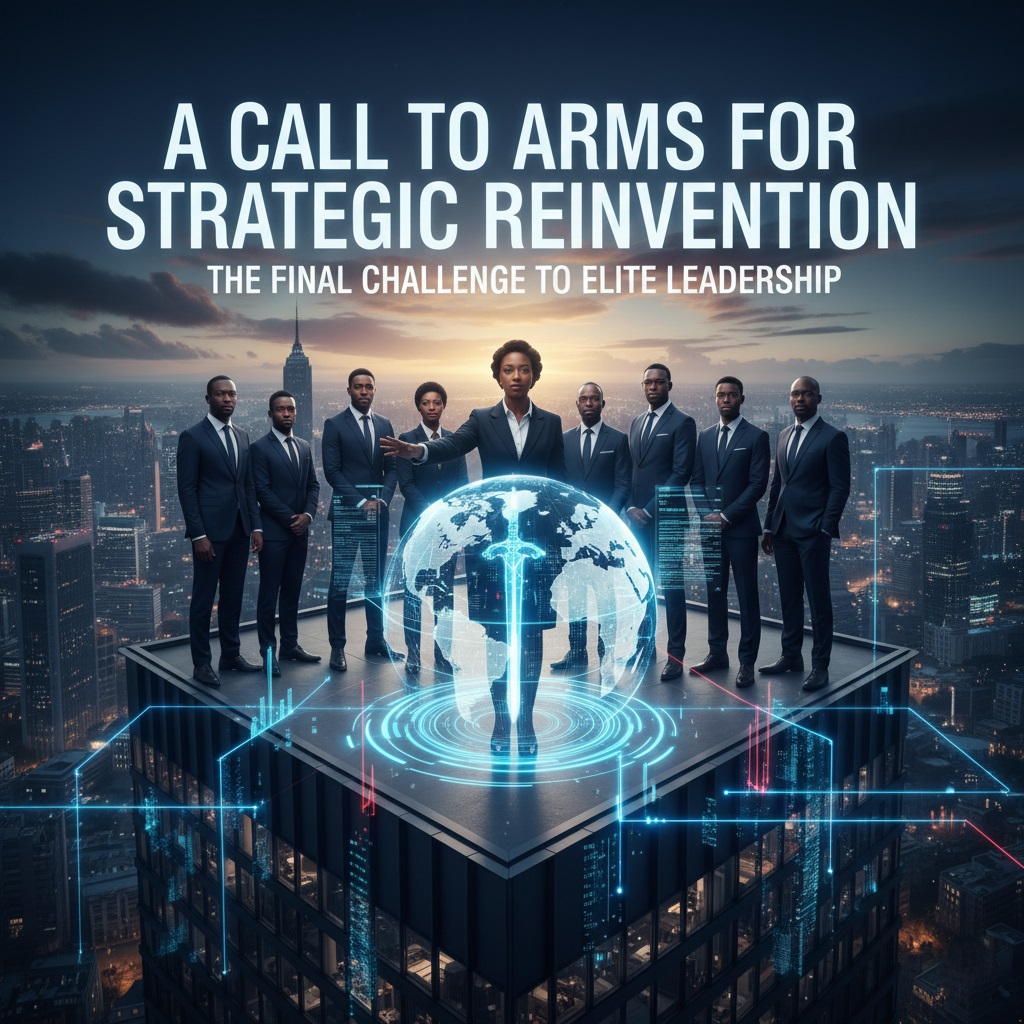
This book is not a manual. It is a mirror. It reflects the urgency of reinvention and the architecture of transformation. It demands that leaders think in three dimensions: past, present, and future. It challenges them to harmonise legacy with innovation, stability with agility, and performance with reinvention.
The 'wise pivot' is not a choice, but a catastrophic necessity, a strategic ultimatum delivered by the accelerating forces of the Fourth Industrial Revolution. The insights articulated in Pivot to the Future serve as a vital, high-level intelligence briefing for those who aspire to command the future, rather than merely react to it. It is a profound demonstration that sustainable growth is not the reward for stability, but the product of perpetual, managed upheaval. The era of linear strategy is conclusively over; the time for elegant, high-impact asymmetry has arrived. Now, the final, crucial question must be put to the stewards of global capital, to the inheritors of the industrial age: Will you continue to preside over an orderly retreat into obsolescence, or will you seize the profound, catalytic opportunity to architect your own disruptive future? The capital markets await your answer.
To the CEOs, billionaires, and policy shapers reading this: the future will not wait for your board meeting. It will not pause for your quarterly review. It is arriving now, with velocity and indifference. The tides of technology, customer expectation and global competition surge relentlessly. The only sustainable advantage lies in reinvention that honours the past while claiming the future. I challenge you now to embrace the framework presented in this book: identify the trapped value within your operations; design innovation architecture; elevate data-driven decision-making; re-centre customer experience; lead with dual-speed agility.
The mic drops on this: those who pivot wisely will define the next era of enterprise leadership, those who do not will watch their value erode quietly. The choice for you, the elite of global industry and influence, is crystallised: Pivot to the future or be pivoted by it.
The final question is not whether you will pivot. It is whether you will pivot wisely. You must pivot. Not once. Not occasionally. But perpetually.
Images by Bandile Ndzishe of Bandzishe Group
About bandile ndzishe

Bandile Ndzishe is the CEO, Founder, and Global Consulting CMO of Bandzishe Group, a premier global consulting firm distinguished for pioneering strategic marketing innovations and driving transformative market solutions worldwide. He holds three business administration degrees: an MBA, a Bachelor of Science in Business Administration, and an Associate of Science in Business Administration.
With over 30 years of hands-on expertise in marketing strategy, Bandile is recognised as a leading authority across the trifecta of Strategic Marketing, Daily Marketing Management, and Digital Marketing. He is also recognised as a prolific growth driver and a seasoned CMO-level marketer.
Bandile has earned a strong reputation for delivering strategic marketing and management services that guarantee measurable business results. His proven ability to drive growth and consistently achieve impactful outcomes has established him as a well-respected figure in the industry.
As an AI-empowered and an AI-powered marketer, I bring two distinct strengths to the table: empowered by AI to achieve my marketing goals more effectively, whilst leveraging AI as a tool to enhance my marketing efforts to deliver the desired growth results. My professional focus resides at the nexus of artificial intelligence and strategic marketing, where I explore the profound and enduring synergy between algorithmic intelligence and market engagement.
Rather than pursuing ephemeral trends, I examine the fundamental tenets of cognitive augmentation within marketing paradigms. I analyse how AI's capacity for predictive analytics, bespoke personalisation, and autonomous optimisation precipitates a transformative evolution in consumer interaction and brand stewardship. By extension, I seek to comprehend the strategic applications of artificial intelligence in empowering human capability and fostering innovation for sustainable societal advancement.
In essence, I explore how AI augments human decision-making and strategic problem-solving in both marketing and other domains of life. This is not merely an interest in technological novelty, but a rigorous investigation into the strategic implications of AI's integration into the contemporary principles of marketing practice and its potential to reshape decision-making frameworks, rearchitect strategic problem-solving paradigms, enhance strategic foresight, and influence outcomes in diverse areas beyond the marketing sphere.